How To Use The DIY Custom Strategy Builder Indicator On TradingView In Forex Trading
Build Your Forex Strategy. Test Your Ideas. Trade With Greater Confidence.
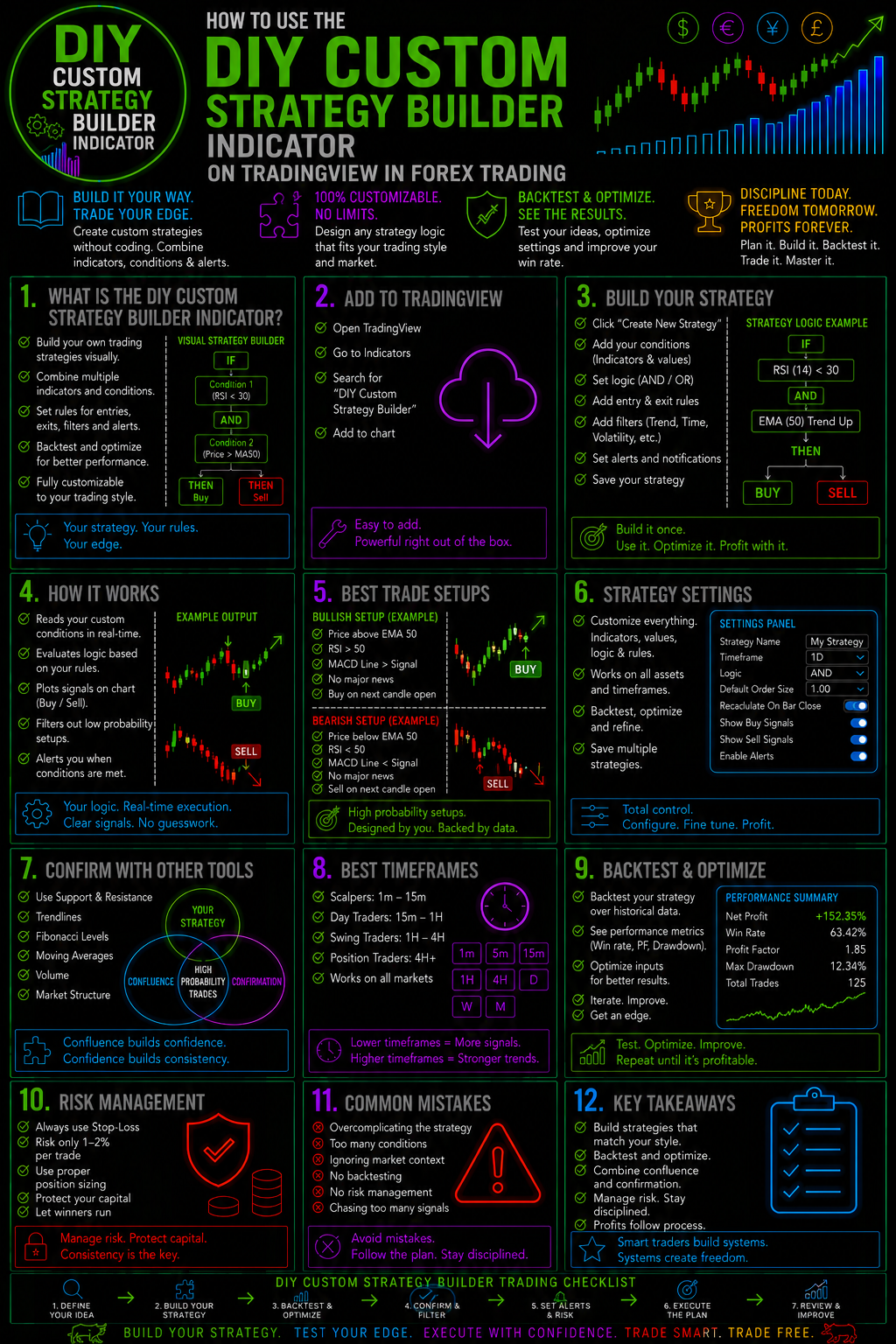
What if you could stop randomly stacking indicators onto your TradingView chart and start building a trading approach around your own strategy ideas?
That is where the DIY Custom Strategy Builder Indicator can become an interesting addition to your Forex trading toolkit.
Instead of blindly following someone else's strategy, a strategy-building approach gives you the opportunity to experiment with different market conditions, indicators, signals, confirmations, entries, and exits.
The objective isn't to create the world's most complicated trading system.
The objective is to build a trading process that makes sense to you.
And when combined with disciplined risk management, proper market analysis, and thorough testing, that process can become far more valuable than simply chasing the latest Forex indicator.
Welcome to Forex Trading Unlocked.
Here, we're focused on helping traders understand how the market works, how indicators can be used, and how individual trading tools can become part of a larger trading system.
What Is The DIY Custom Strategy Builder Indicator?
The DIY Custom Strategy Builder Indicator is designed around a simple concept:
Give the trader greater flexibility when developing a trading strategy.
Rather than treating an indicator as a magical buy-or-sell button, the strategy-builder concept allows traders to explore combinations of conditions that can potentially be incorporated into a systematic trading approach.
This can be especially useful for Forex traders because the currency market behaves differently across:
- Currency pairs
- Timeframes
- Trading sessions
- Volatility environments
- Trending markets
- Ranging markets
- Fundamental environments
A strategy that performs well during a strong trend may behave completely differently when the market begins moving sideways.
That is why understanding conditions can be just as important as understanding signals.
Why Build Your Own Forex Trading Strategy?
There is an enormous amount of Forex trading information available online.
Thousands of indicators.
Hundreds of strategies.
Countless YouTube videos promising the "perfect" setup.
And yet many traders continue struggling.
Why?
Because collecting trading tools isn't the same thing as building a trading system.
A serious trading strategy should answer several fundamental questions:
1. When Do I Enter?
What market condition needs to exist before you consider opening a position?
2. When Do I Stay Out?
What conditions tell you that the setup isn't worth trading?
3. Where Is My Stop Loss?
How much are you willing to risk if the trade fails?
4. Where Is My Profit Target?
What determines when you take profits?
5. How Much Do I Risk?
Your position size should be determined by your risk parameters—not by how confident you feel.6. What Happens When The Market Changes?
A strategy should be evaluated across different market environments rather than judged by a handful of winning trades.
This is where strategy building becomes powerful.
Getting Started On TradingView
TradingView provides traders with an extensive charting environment for analyzing Forex markets.
Before experimenting with a strategy-builder indicator, start with a clean chart.
Choose the currency pair you want to study.
For example:
Then select the timeframe that matches the style of trading you intend to pursue.
A scalper, day trader, and swing trader may all look at the same currency pair—but they are operating within very different market structures.
Don't build a strategy before deciding what type of trader you are trying to become.
How To Add The DIY Custom Strategy Builder Indicator
Once you are inside TradingView, search for the DIY Custom Strategy Builder Indicator within the Indicators and Strategies area.
Add the indicator to your chart.
Depending on the version and available settings, you'll then be able to work with the indicator's configurable strategy-building functionality.
This is where the real opportunity begins.
Instead of immediately changing every available setting, take a structured approach.
Change one variable at a time.
That makes it easier to understand what is actually affecting your results.
Step 1: Define Your Trading Objective
Before building anything, establish what you're attempting to accomplish.
Are you developing a:
Scalping strategy?
Day-trading strategy?
Swing-trading strategy?
Trend-following strategy?
Breakout strategy?
Reversal strategy?
Your objective determines the conditions you should investigate.
For example, a trend-following strategy may prioritize:
Trend → Pullback → Confirmation → Entry
while a breakout strategy may focus on:
Consolidation → Breakout → Confirmation → Entry
The strategy-builder concept becomes much more useful when you know exactly what you're attempting to build.
Step 2: Establish Your Market Conditions
This is one of the most important parts of strategy development.
Ask:
What does the market need to look like before I trade?
You could investigate conditions such as:
- Trend direction
- Price above or below a moving average
- Momentum
- Volatility
- Support and resistance
- Breakouts
- Pullbacks
- Candlestick behavior
- Market structure
The goal isn't to use every possible condition.
The goal is to identify the conditions that actually matter to your strategy.
Step 3: Build Your Entry Logic
Now you can begin constructing the logic behind your potential setup.
For example:
BUYTrend is bullish
+
Price pulls back
+
Momentum confirms strength
+
Price breaks the trigger level
Potential long setup
A bearish setup could reverse the logic:
SELLTrend is bearish
+
Price rallies into resistance
+
Momentum weakens
+
Price breaks the trigger level
Potential short setup
This is fundamentally different from saying:
"The indicator turned green, so I bought."
You're creating a sequence of conditions.
That's an important distinction.
Step 4: Don't Overcomplicate Your Strategy
One of the biggest mistakes new traders make is adding more and more indicators.
Indicator #1 says buy.
Indicator #2 says buy.
Indicator #3 says buy.
Indicator #4 says maybe.
Indicator #5 says wait.
Eventually, the chart becomes so complicated that the trader can't explain why the trade was actually taken.
More indicators do not automatically equal more accuracy.
A strategy should be understandable.
If you can't explain your trading rules in a few sentences, you may need to simplify them.
Step 5: Create Exit Conditions
Entries get most of the attention.
Professional trading requires serious attention to exits as well.
Your strategy should define what happens after entering a trade.
Consider:
Stop Loss
Where is the trade proven wrong?
Take Profit
Where does the strategy expect price to reach?
Risk-to-Reward
Is the potential reward worth the amount being risked?
Trailing Exit
Should the position remain open while the trend continues?
Time-Based Exit
Should the trade close if nothing happens after a predetermined period?
These decisions should be part of the strategy—not improvised after you're already in the trade.
Step 6: Test Before You Trust It
This is where many traders get into trouble.
They find a combination that appears to work on a handful of historical trades and immediately assume they've discovered a profitable system.
Don't.
A strategy isn't validated because it worked five times.
You need to investigate how it behaves across different market conditions.
Test it across:
- Different currency pairs
- Different time periods
- Different market environments
- Winning and losing streaks
- Trending markets
- Ranging markets
- High-volatility periods
- Low-volatility periods
The objective is not to find a strategy that never loses.
That strategy doesn't exist.
The objective is to determine whether your strategy has a logical and repeatable edge.
Step 7: Watch For Overfitting
Overfitting is one of the biggest dangers of strategy development.
You can continually adjust your settings until a historical chart looks incredible.
But that doesn't mean the strategy will work going forward.
If you optimize a strategy too heavily around historical data, you may simply be creating a system that is exceptionally good at explaining the past.
The future is different.
That's why your strategy needs to remain logical, simple enough to understand, and robust enough to survive changing market conditions.
The DIY Strategy Builder Should Be Part Of A Bigger Trading System
An indicator is a tool.
It isn't your trading plan.
It isn't your risk manager.
And it doesn't eliminate uncertainty.
Think about your Forex trading process as a complete framework:
Market Analysis
↓
Market Condition
↓
Strategy
↓
Entry Confirmation
↓
Risk Management
↓
Trade Execution
↓
Position Management
↓
Exit
↓
Trade Review
The DIY Custom Strategy Builder Indicator can potentially occupy an important place within that process.
But the trader remains responsible for the decisions.
Combine Strategy Building With Confluence
Confluence occurs when multiple independent pieces of market information support the same trading idea.
For example:
Trend Direction
Support/Resistance
Momentum
Price Action
Entry Trigger
When these factors align, you may have a stronger reason to investigate the trade.
But remember:
Confluence does not guarantee a winning trade.
It simply provides a framework for making a more structured decision.
The Forex Trading Unlocked Approach
At Forex Trading Unlocked, we don't believe traders should build their entire trading career around blindly following indicators.
Learn the tool.
Understand the market.
Build the rules.
Test the idea.
Manage the risk.
Review the results.
That is how a collection of indicators can become part of an actual trading process.
And that's exactly why learning how individual TradingView indicators work can be valuable.
The more you understand about the tools you're using, the less dependent you become on someone else's trading signals.
Want To Go Beyond One Indicator?
Learning individual indicators is only one piece of the puzzle.
If you want to become a more complete Forex trader, you need to understand the relationships between:
Trend
Momentum
Support & Resistance
Candlestick Patterns
Chart Patterns
Market Structure
Risk Management
Trade Psychology
Strategy Development
That's where the broader Forex Trading Unlocked education system comes in.
Don't Just Collect Indicators.
Build Trading Knowledge.
Explore more Forex Trading Unlocked strategies, indicators, education, and market resources to expand your trading toolkit.
[EXPLORE FOREX TRADING UNLOCKED →]
Related Forex Trading Resources
Keep the visitor moving through the site with strategically placed internal links.
TradingView Indicator Guides
Learn how different TradingView indicators can be incorporated into a broader Forex trading strategy.
[Explore TradingView Forex Indicators →]
Discover different approaches to trend trading, reversals, breakouts, momentum, and market structure.
[Explore Forex Trading Strategies →]
Learn how price action and candlestick formations can help identify potential market opportunities.
[Learn Japanese Candlestick Patterns →]
A strategy is incomplete without a plan for controlling risk.
[Master Forex Risk Management →]
Build the foundation before attempting to build an advanced strategy.
[Start Learning Forex Trading →]
Frequently Asked Questions
What Is The DIY Custom Strategy Builder Indicator?
It is a TradingView indicator designed to help traders develop and experiment with customized trading strategy conditions rather than relying solely on a fixed trading system.
Can Beginners Use The DIY Custom Strategy Builder Indicator?
Yes, but beginners should first understand basic concepts such as trend direction, support and resistance, entries, exits, position sizing, and risk management.
Can The Indicator Guarantee Profitable Forex Trades?
No. No indicator can guarantee profitable trades. Market conditions change, and every trading strategy can experience losing trades.
Should I Use Multiple Indicators With A Strategy Builder?
Not necessarily. Adding more indicators can make a strategy unnecessarily complicated. Focus on conditions that have a logical purpose within your trading plan.
What Forex Timeframe Should I Use?
That depends on your trading style. Scalpers, day traders, and swing traders may use different timeframes. Test your strategy on the timeframe that matches your intended trading approach.
Should I Backtest My Strategy?
Yes. Backtesting can help you understand how a strategy would have behaved under historical market conditions. However, historical performance does not guarantee future results.
What Is More Important: The Indicator Or The Strategy?
The strategy. An indicator is simply a tool used within the larger decision-making process.
Build Your Strategy. Build Your Knowledge. Build Your Edge.
The biggest advantage of the DIY Custom Strategy Builder Indicator isn't simply the ability to experiment with settings.
It's the opportunity to start thinking differently about Forex trading.
Instead of asking:
"What's the best indicator?"
Start asking:
"What conditions create the highest-quality setup for the strategy I'm building?"
That question puts the focus where it belongs:
On the trading process.
Use TradingView to investigate your ideas. Use strategy testing to challenge your assumptions. Use risk management to protect your capital.
And continue building your knowledge with Forex Trading Unlocked.Your next trade shouldn't be based on a guess.
Build the strategy behind it.
[START EXPLORING FOREX TRADING UNLOCKED →]
👉 “Get Instant Access (Check Your Email)”
💥 IMPORTANT: One Last Step Required
After you enter your email, check your inbox (or spam folder) for a confirmation email.
👉 Click the confirmation link so I can send you your free Forex training.
⚠️ If you don’t confirm, I can’t send you anything.
👉 “⚠️ Access expires if not confirmed within 24 hours minutes.”
👉 “Takes 10 seconds. Instant access after email confirmation.”