Download Your Free - Forex Trading Starter Kit
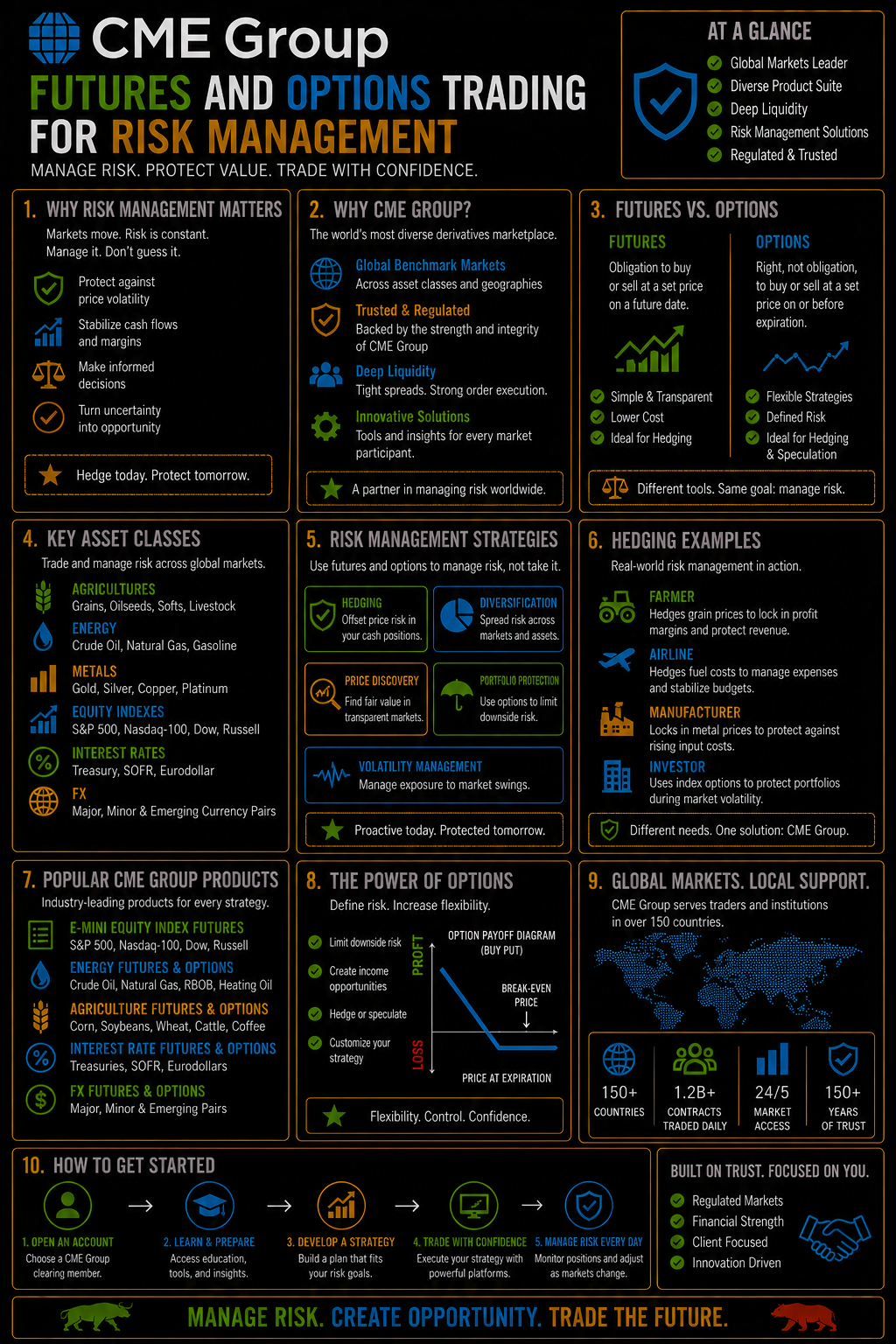
CME Group Futures And Options Trading For Risk Management
How Professional Traders Hedge Risk, Protect Capital, and Stay Consistently Profitable
If you want to trade like institutions—not gamble like retail traders—you need to understand one thing:
Risk management is everything.
And the tools professionals use to control risk aren’t guesswork indicators or hype strategies…
They are futures and options traded through CME Group.
In this guide, you’ll learn exactly how futures and options work, how institutions use them to hedge risk, and how you can apply these same strategies to protect your capital and trade smarter.
What is CME Group?
CME Group is the world’s largest derivatives marketplace, offering trading in:
- Futures contracts
- Options on futures
- Commodities (oil, gold, agriculture)
- Stock indices (S&P 500, Nasdaq)
- Interest rates
- Foreign exchange
This is where hedge funds, banks, and institutional traders manage billions—sometimes trillions—of dollars in exposure.
Unlike spot forex or crypto markets, CME products are:
✔ Regulated
✔ Centralized
✔ Transparent
✔ Backed by real liquidity
That’s why professionals rely on them for serious risk management.
Futures vs Options: What’s the Difference?
Before diving into strategy, you need to understand the two core instruments.Futures Contracts
A futures contract is an agreement to buy or sell an asset at a predetermined price at a future date.
Key characteristics:
- Standardized contracts
- Leverage built-in
- Obligation to fulfill contract (unless closed early)
👉 Traders use futures to:Options Contracts
- Hedge risk
- Speculate on price direction
- Lock in prices
Options give you the right—but not the obligation—to buy or sell an asset at a specific price.
Two types:
- Call options (bet on price going up)
- Put options (bet on price going down)
👉 Traders use options to:
- Limit downside risk
- Create asymmetric trades
- Hedge existing positions
Why Most Traders Fail (And How Pros Avoid It)
Retail traders focus on:
- Entries
- Indicators
- “Winning strategies”
Professional traders focus on:
- Risk exposure
- Position sizing
- Hedging strategies
The difference?
👉 Retail traders try to predict the market
👉 Professionals manage risk regardless of outcome
This is why most traders blow accounts…
And why institutions stay profitable long-term.
How Futures Are Used for Risk Management
Futures allow traders to lock in prices and hedge exposure.Example: Forex Trader Hedging USD Risk
Let’s say you’re trading EUR/USD in the spot forex market.
If you’re long EUR/USD, you are effectively:
- Long EUR
- Short USD
To hedge USD exposure, you could:
- Use USD index futures
- Short a correlated futures contract
👉 Result: Reduced exposure to sudden USD volatility
Example: Stock Market Protection
If you hold a portfolio of stocks, you can hedge downside risk by:
- Shorting S&P 500 futures
- Using Nasdaq futures as a hedge
If the market drops:
- Your portfolio loses value
- Your futures hedge gains
👉 Net effect: Controlled losses
How Options Are Used for Risk Management
Options are where risk management becomes extremely powerful.
Strategy 1: Protective Put
You buy a put option to protect a long position.
Example:
- You own stocks or crypto
- You buy a put option below current price
If price crashes:
- Your losses are capped
- Your put increases in value
👉 This is like insurance for your trade
Strategy 2: Covered Call
You sell a call option against an asset you own.
Benefits:
- Generate income
- Reduce risk exposure
Trade-off:
- Limited upside potential
Strategy 3: Collar Strategy
Combine:
- Buying a put (protection)
- Selling a call (income)
👉 Result: Defined risk + controlled profit range
Institutional Risk Management Strategies
Here’s how professionals actually operate:
1. Delta Hedging
Balancing long and short exposure to remain neutral.
2. Portfolio Hedging
Using futures to offset total portfolio risk.
3. Volatility Hedging
Trading options based on expected volatility spikes.
4. Correlation Hedging
Hedging one asset using another correlated asset.
Real-World Example (Simplified)
Let’s say:
- Market is uncertain
- You expect volatility
Instead of guessing direction:
You could:
- Buy both a call and a put (straddle)
- Profit from movement either way
👉 This is how professionals trade uncertainty
🔥 Why Futures & Options Beat Traditional Trading
Compared to retail trading approaches:Futures & Options Give You:
✔ Defined risk
✔ Strategic flexibility
✔ Institutional-level tools
✔ Ability to profit in any marketRetail Trading Relies On:
❌ Guessing direction
❌ Overleveraging
❌ No hedge protection
❌ Emotional decision-making
How To Start Trading CME Futures & Options
If you’re serious about leveling up:Step 1: Learn Market Structure
Understand how institutions move price.Step 2: Master Risk Management
Position sizing + exposure control is everything.Step 3: Start With Simulation
Practice strategies before risking capital.Step 4: Trade With a Plan
Every trade should include:
- Entry
- Stop loss
- Hedge strategy
💡 The Smart Trader Mindset
The biggest shift you need to make:
👉 Stop trying to be right
👉 Start trying to be protected
Because in trading:
You don’t need to win every trade…
You just need to survive long enough to compound.
🎯 How Forex Trading Unlocked Helps You Master This
At Forex Trading Unlocked, we don’t teach hype strategies.
We teach:
- Real risk management systems
- Institutional trading concepts
- Repeatable, structured strategies
Inside our programs, you’ll learn:
✔ High-probability setups
✔ Market structure mastery
✔ Risk-first trading frameworks
✔ How to think like a professional trader
🔓 Ready to Trade Like a Professional?
If you’re tired of:
- Blowing accounts
- Chasing signals
- Gambling on entries
And you’re ready to:
- Protect your capital
- Trade with confidence
- Build consistent results
👉 Then it’s time to upgrade your strategy. Here is a good way to start.
🚀 Start Your Trading Transformation Today
Learn how to apply futures, options, and professional risk management strategies inside Forex Trading Unlocked.
👉 Coming Soon.
Download Your Free - Forex Trading Starter Kit
👉 “Get Instant Access (Check Your Email)”
💥 IMPORTANT: One Last Step Required
After you enter your email, check your inbox (or spam folder) for a confirmation email.
👉 Click the confirmation link so I can send you your free Forex training.
⚠️ If you don’t confirm, I can’t send you anything.
👉 “⚠️ Access expires if not confirmed within 24 hours minutes.”
👉 “Takes 10 seconds. Instant access after email confirmation.”