How To Use The Sniper Risk Indicator On TradingView In Forex Trading
Take Control Of Your Forex Risk Before You Enter The Market
Successful forex trading is not just about finding the perfect entry. It is about knowing how much you are risking, where your trade idea becomes invalid, and whether the potential reward justifies the risk.
The Sniper Risk Indicator on TradingView can help forex traders develop a more structured approach to trade planning by bringing risk analysis into the charting process. Instead of entering a trade based on emotion, guesswork, or fear of missing out, traders can use a systematic process to evaluate potential entries, plan stop-loss placement, and establish realistic profit targets.
Whether you trade EURUSD, GBPUSD, USDJPY, gold, or other actively traded markets, understanding how to incorporate risk analysis into your strategy can help you make more disciplined trading decisions.
Ready to sharpen your trading process? Learn how the Sniper Risk Indicator fits into a complete forex trading strategy, then explore the additional trading tools and educational resources available at Forex Trading Unlocked.
What Is The Sniper Risk Indicator?
The Sniper Risk Indicator is a TradingView charting tool intended to assist traders with risk-focused trade analysis. Depending on the specific version and its settings, indicators in this category may help traders evaluate potential entry areas, stop-loss placement, risk-to-reward relationships, or other trade-management variables.
Its exact functionality depends on the particular script you are using. Traders should review the indicator's description, inputs, and chart output before relying on any displayed signals or calculations.
The central objective is straightforward: plan the risk before committing capital to a trade.
A disciplined forex trader should know three things before entering a position:
- Entry price: Where the trade will be initiated if the setup meets the required conditions.
- Stop-loss level: Where the trade thesis is considered invalid and the position should be exited.
- Profit target: Where profits may be taken based on the trading strategy and available market structure.
These decisions should be based on a repeatable trading plan rather than the desire to make money on the next trade.
Why Risk Management Matters In Forex Trading
The forex market offers substantial trading opportunities, but leverage can magnify both gains and losses. A trader can correctly identify the general direction of a currency pair and still lose money by entering too late, placing a stop-loss poorly, or risking too much capital.
Consider a simple example.
Suppose your trading account contains $10,000 and you decide to risk 1% on a trade. Your maximum planned risk is $100, excluding transaction costs and potential slippage.
If the stop-loss is reached, the planned loss is approximately $100. If the trade reaches a profit target worth twice the initial risk, the planned profit is approximately $200.
This is a 1:2 risk-to-reward relationship.
The example illustrates why risk management should come before position size and profit expectations. Actual results depend on execution, spreads, slippage, and whether the trade reaches its intended exit.
Important: A favorable risk-to-reward ratio does not guarantee profitability. Your strategy must also produce sufficiently reliable results over a meaningful sample of trades.
For a deeper understanding, explore our forex education resources and learn how to combine risk control with technical analysis.
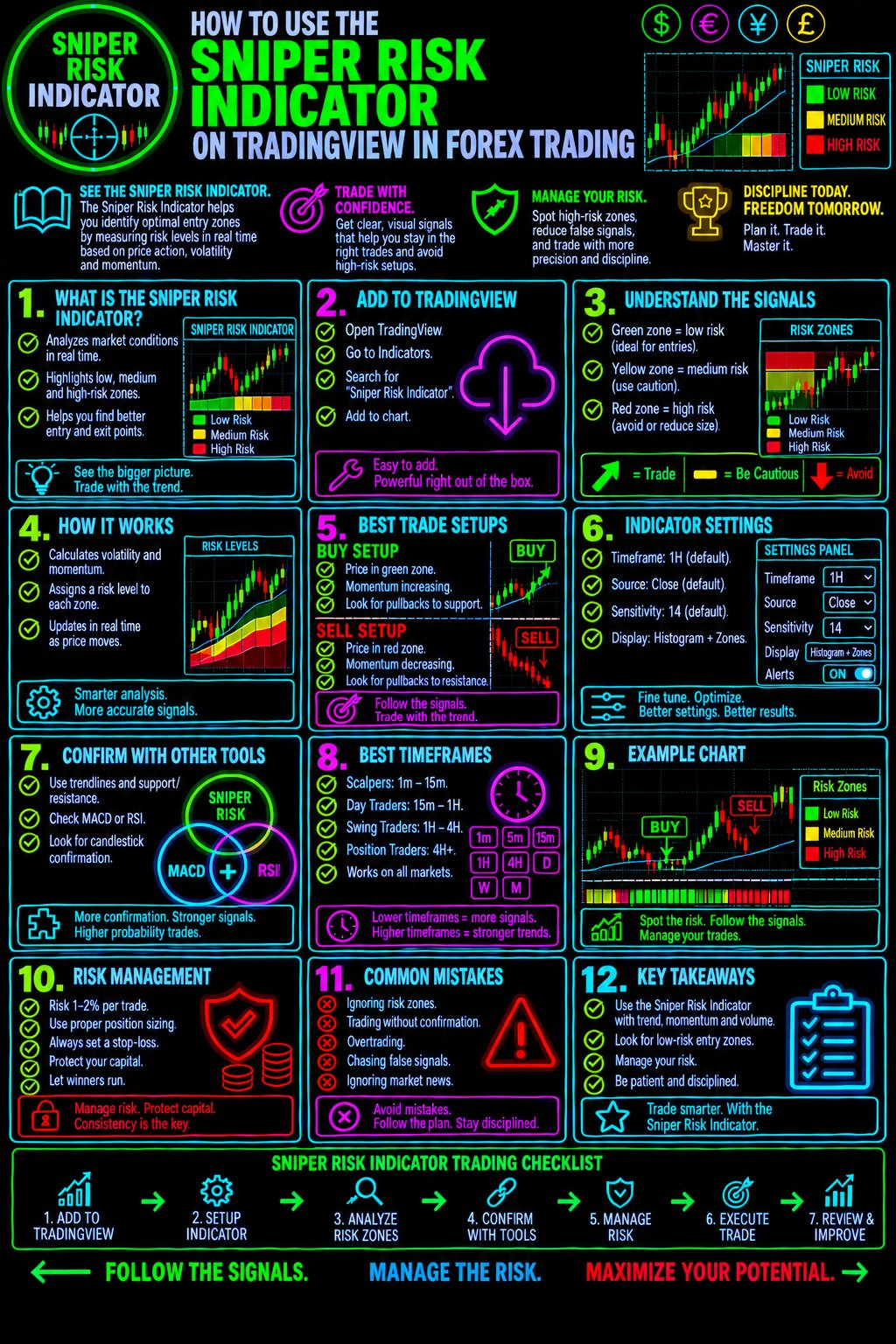
How To Use The Sniper Risk Indicator On TradingView
Step 1: Open TradingView And Select Your Forex Pair
Open TradingView and load the currency pair you intend to analyze.
For example, you might choose EURUSD, GBPUSD, or USDJPY. Select a timeframe that matches your trading approach.
A scalper may analyze shorter timeframes, while an intraday trader or swing trader may focus on longer intervals. The best timeframe depends on your strategy, trading costs, and tolerance for market fluctuations.
Before opening a position, examine the overall market environment. Is price trending, consolidating, approaching support, or testing resistance?
An indicator should support your analysis rather than replace it.
Step 2: Add The Sniper Risk Indicator To Your Chart
Locate the Sniper Risk Indicator through TradingView's Indicators interface, using the exact name of the script you intend to use.
If the script is published publicly, search the available community indicators. If it is private or invite-only, you may need authorized access from its publisher.
Once added, examine the indicator's settings and read the publisher's documentation.
Pay attention to:
- Available input settings and their descriptions.
- Whether the indicator displays entry, stop-loss, or target information.
- Whether its calculations are based on price, volatility, market structure, or other variables.
- Whether signals can change as new candles form.
- Any limitations or recommended trading conditions disclosed by the publisher.
Do not assume every version of an indicator with a similar name operates in the same way.
Step 3: Identify The Market Direction
Before evaluating a potential trade, determine whether the market is trending upward, trending downward, or moving sideways.
For additional confirmation, consider combining the Sniper Risk Indicator with a broader technical analysis framework.
For example, you can examine:
- Higher highs and higher lows in an uptrend.
- Lower highs and lower lows in a downtrend.
- Major support and resistance levels.
- Breakouts and potential breakout failures.
- Candlestick formations that indicate rejection or momentum.
- The relationship between short-term price action and the higher-timeframe trend.
A potential long setup may be more attractive when price structure supports an upward move. A potential short setup may be more attractive when price structure supports a downward move.
However, no trend condition guarantees that the next trade will succeed.
Explore more: Learn how to identify market direction with our forex trend analysis, support and resistance, and Japanese candlestick pattern education.
Step 4: Evaluate The Potential Entry
Use the indicator's documented features to evaluate the potential entry area.
Avoid entering simply because a signal appears on the chart. Instead, ask whether the trade satisfies your predefined conditions.
For a potential buy trade, you might look for bullish market structure, a favorable entry location, and evidence that buyers are gaining control.
For a potential sell trade, you might look for bearish structure, resistance, or evidence that selling pressure is increasing.
You should also consider whether the entry is too far from a logical stop-loss location. A late entry can create an unfavorable risk-to-reward relationship even when the market direction is correct.
Wait for your required conditions to align. Missing a trade is generally preferable to entering a position that does not meet your plan.
Step 5: Establish Your Stop-Loss Level
Stop-loss placement is one of the most important parts of a complete trading plan.
The stop-loss should reflect the point at which the trade thesis is no longer valid. Depending on your strategy, that location may be based on market structure, volatility, or another objectively defined rule.
If the Sniper Risk Indicator displays a stop-loss level, verify how that level is calculated before using it.
Ask yourself:
- Does the stop-loss account for normal price fluctuations?
- Is it beyond a meaningful invalidation point?
- Does the distance fit your strategy?
- Can you reduce position size to keep the planned monetary risk within your limit?
Avoid moving a stop-loss farther away simply to prevent a losing trade from closing. Doing so can increase your exposure beyond the amount originally planned.
Remember that a stop-loss does not guarantee an exact exit price during fast markets or periods of reduced liquidity.
Step 6: Calculate Your Position Size
Once you know your entry price, stop-loss distance, and maximum acceptable monetary risk, calculate your position size.
For a typical forex position denominated in your account currency, a simplified formula is:
Position size = Maximum planned monetary risk ÷ Monetary loss per unit at the stop-loss
For example, assume:
- Account balance: $10,000
- Planned risk: 1% of account equity
- Maximum planned loss: $100
- Estimated loss per standard lot at the chosen stop-loss: $50 per pip
- Stop-loss distance: 20 pips
The estimated risk for one standard lot would be:
20 pips × $10 per pip = $200, assuming a currency pair and account denomination for which one standard lot is worth approximately $10 per pip.
To keep the planned risk near $100, the position would be approximately 0.50 standard lots, before transaction costs and slippage.
Always verify pip value, contract specifications, account currency, and broker requirements for the specific instrument being traded.
Want to strengthen your trading foundation? Explore our forex risk management education to learn how position sizing, stop-loss discipline, and capital preservation work together.
Step 7: Evaluate The Risk-To-Reward Relationship
After defining the entry and stop-loss, identify a realistic profit target.
Suppose a trade has:
- Entry price: 1.1000
- Stop-loss: 1.0980
- Profit target: 1.1040
The distance to the stop-loss is 20 pips, while the distance to the profit target is 40 pips.
The planned risk-to-reward ratio is therefore 1:2.
This ratio helps you evaluate the potential payoff relative to the initial risk. It does not tell you whether the trade is likely to reach its target.
Before entering, consider whether the target is realistic given nearby support and resistance, market volatility, and the conditions required by your strategy.
If the potential target is blocked by a major technical level, the trade may not offer the opportunity your plan requires.
Step 8: Confirm The Setup Before Entering
Before placing the trade, review the complete setup.
Ask yourself:
- Does the market direction agree with my trading plan?
- Is the entry supported by my predefined technical conditions?
- Is the stop-loss at a logical invalidation level?
- Is the position size appropriate for my risk limit?
- Does the potential reward justify the risk?
- Am I entering according to my rules rather than emotion?
If any essential condition is missing, wait for a better opportunity.
A structured process helps prevent impulsive entries and makes it easier to review your decisions later.
Step 9: Manage The Trade After Entry
Your responsibilities do not end once the position is open.
Monitor the trade according to your predefined management rules. Avoid changing the plan in response to every small price movement.
Depending on your strategy, trade management may include taking profits at a predetermined target, trailing a stop-loss according to objective rules, or exiting when the original trade thesis becomes invalid.
Do not assume the indicator will manage the position automatically unless its documentation explicitly confirms that functionality and you have configured the relevant execution system.
Keep a trading journal documenting the setup, entry, stop-loss, target, result, and any deviations from your rules.
Over time, this record can help you determine whether your strategy performs consistently across different market conditions.
Best Ways To Combine The Sniper Risk Indicator With Other Forex Tools
No single indicator provides a complete picture of the forex market. The strongest approach is to combine risk planning with complementary methods of technical analysis.Sniper Risk Indicator + Japanese Candlestick Patterns
Candlestick patterns can help traders interpret buying and selling pressure around important price levels.
A bullish engulfing pattern near a well-established support area may provide a reason to investigate a potential long setup. A bearish rejection candle near resistance may prompt a closer examination of a potential short setup.
Candlestick patterns are not reliable in every context. Their value depends on market structure, location, confirmation, and the rules of your overall strategy.
Learn more in our guide:
High Probability Japanese Candlestick Patterns Every Trader Must Know
Use candlestick analysis to assess the setup, then apply disciplined risk management before committing capital.
Sniper Risk Indicator + Support And Resistance
Support and resistance levels can help you identify areas where price may encounter buying or selling pressure.
These levels can also help you assess whether a potential profit target is realistic and whether the proposed stop-loss makes sense relative to market structure.
Rather than placing trades in the middle of an unclear price range, consider whether the setup offers a well-defined entry, an identifiable invalidation point, and sufficient room for a potential move.
Explore our forex support and resistance education to strengthen your chart analysis.
Sniper Risk Indicator + Trend Analysis
Trend analysis helps you place individual trade setups within the broader market environment.
You may choose to prioritize trades aligned with the higher-timeframe trend, or you may have a tested strategy for trading reversals. Either way, the rules should be defined in advance.
Combining trend direction with structured risk analysis can help you evaluate opportunities more consistently.
Sniper Risk Indicator + MACD
The Moving Average Convergence Divergence indicator, commonly called MACD, can help traders analyze momentum and changes in trend behavior.
Some traders examine MACD crossovers, the relationship between the MACD line and signal line, or divergence between momentum and price.
These observations can provide additional context, but MACD signals can lag price and may produce false signals in sideways markets.
Use momentum analysis as one part of a complete decision-making process rather than as a guarantee of a successful trade.
Sniper Risk Indicator + Fibonacci Retracement
Fibonacci retracement levels are used by traders to examine potential pullback areas within a price move.
When these levels coincide with established market structure or other technical evidence, they may help traders identify areas worth monitoring.
The levels themselves do not guarantee a reversal. Confirm the setup using your trading rules and ensure the proposed stop-loss and target offer an acceptable risk-to-reward relationship.
Common Mistakes To Avoid When Using The Sniper Risk Indicator
Even a useful trading tool can produce poor results when it is applied without a clear plan.
1. Treating Every Signal As A Trade
An indicator signal is not an instruction to risk capital automatically. Evaluate the market environment, entry location, and risk parameters before acting.
2. Risking Too Much On A Single Position
Large position sizes can magnify the impact of losing trades. Define your maximum risk before entering and apply it consistently.
3. Placing Stop-Losses Based On Emotion
A stop-loss should follow an objective trading rule, not the amount of money you hope to make or the amount of loss you are willing to ignore after entering.
4. Ignoring The Higher-Timeframe Context
Short-term signals may conflict with the broader trend or occur near significant price barriers. Examine the larger market structure when it is relevant to your strategy.
5. Changing Indicator Settings Without Testing
Repeatedly adjusting settings to make past trades appear successful can lead to overfitting. Test any changes using historical data and forward testing before applying them to live positions.
6. Assuming A High Risk-To-Reward Ratio Guarantees Profits
A 1:3 target does not automatically make a strategy profitable. The win rate, transaction costs, slippage, and quality of execution all matter.
7. Failing To Keep Records
Without a trading journal, it is difficult to distinguish a genuinely effective strategy from a series of fortunate outcomes.
Document your results and review them over a meaningful sample of trades.
How To Test The Sniper Risk Indicator Before Trading Live
Before committing real money, evaluate the indicator in a controlled environment.
Start with historical analysis. Review how its signals or risk calculations behaved across trending, ranging, and volatile market conditions.
Use TradingView's replay or testing features where appropriate. Check whether the indicator behaves consistently as new candles form. Do not assume historical signals were available in real time unless you have verified that behavior.
Forward-test the strategy. Apply your complete trading rules in a demo account or another simulated environment before risking real capital.
Track meaningful performance statistics. Consider win rate, average winning trade, average losing trade, maximum drawdown, transaction costs, and expectancy.
A simplified expectancy calculation is:
Expectancy = (Win rate × Average win) − (Loss rate × Average loss)
For example, a strategy with a 45% win rate, an average winning trade of $200, and an average losing trade of $100 has a simplified expectancy of:
(0.45 × $200) − (0.55 × $100) = $35 per trade, before transaction costs.
This is an illustration, not a forecast of the Sniper Risk Indicator's performance. Actual results can differ substantially, and historical performance does not guarantee future results.
Is The Sniper Risk Indicator Suitable For Beginners?
The indicator may be worth investigating for beginners who want to incorporate risk planning into their technical analysis. However, beginners should first understand the basics of currency pairs, pips, leverage, position sizing, stop-losses, and risk-to-reward ratios.
An indicator cannot replace those fundamentals.
New traders should begin with a demo account, use conservative risk limits, and learn how to evaluate a trade independently before relying on indicator-generated information.
Experienced traders may find the tool useful as an additional component of an existing trading framework, provided its functionality is clearly understood and its contribution is tested.
The key is not to collect as many indicators as possible. It is to develop a repeatable process that helps you identify, evaluate, execute, and review trades.
Build A More Complete Forex Trading Strategy With Forex Trading Unlocked
The Sniper Risk Indicator is only one potential component of a disciplined trading process. To develop a more complete approach, you also need to understand price action, technical analysis, trade selection, and risk management.
Forex Trading Unlocked provides educational resources designed to help traders strengthen these essential skills.
Get Started With Our Free Forex Trading Resources
If you want to improve your understanding of forex trading before committing more capital, begin with our educational guides and trading resources.
Explore Forex Trading Unlocked
Learn the fundamentals, build a stronger technical analysis process, and discover how different trading tools can fit into a structured strategy.
Master High-Probability Japanese Candlestick Patterns
Candlesticks can help you interpret price action and identify potential changes in buying and selling pressure.
Our candlestick education can help you understand the patterns traders use to evaluate market behavior and refine their entry criteria.
Explore High Probability Japanese Candlestick Patterns
Explore TradingView Indicators And Technical Analysis
TradingView offers a wide range of charting tools for analyzing forex markets. The key is to understand what each indicator measures, what its limitations are, and how it complements your trading strategy.
Continue exploring our TradingView indicator tutorials to learn how different tools can be used to examine trends, momentum, market structure, and potential trading opportunities.
Strengthen Your Risk Management Skills
A trading strategy needs more than entries and exits. It also requires a clear approach to position sizing, capital preservation, and controlling losses.
Developing these skills can help you approach trading more systematically and evaluate performance based on evidence rather than emotion.
Do not let poor risk management undermine an otherwise promising trading strategy. Learn the rules, test your approach, and make risk control part of every trade.
Final Thoughts: Use The Sniper Risk Indicator With A Plan
The Sniper Risk Indicator on TradingView may help you incorporate risk-focused analysis into your forex trading process, depending on the features of the specific script you use.
Its value lies in how it fits into your overall strategy. Define the market conditions you want to trade, establish your entry criteria, determine a logical stop-loss, calculate position size, and evaluate the potential reward before entering a position.
Then test the approach, maintain a trading journal, and refine your rules using actual performance data.
The objective is not to win every trade. It is to make better-informed decisions, manage risk consistently, and build a repeatable trading process.
Continue your education with Forex Trading Unlocked and explore our forex strategies, Japanese candlestick guides, TradingView indicator tutorials, and risk management resources to develop a more disciplined approach to the markets.
Risk Disclaimer: Forex and leveraged trading involve substantial risk and may not be suitable for every trader. You can lose some or all of your invested capital. Indicator signals and technical analysis do not guarantee profitable results. Always evaluate your financial circumstances, understand your broker's trading conditions, and use appropriate risk management. Educational content on this page is not individualized financial or investment advice.
👉 “Get Instant Access (Check Your Email)”
💥 IMPORTANT: One Last Step Required
After you enter your email, check your inbox (or spam folder) for a confirmation email.
👉 Click the confirmation link so I can send you your free Forex training.
⚠️ If you don’t confirm, I can’t send you anything.
👉 “⚠️ Access expires if not confirmed within 24 hours minutes.”
👉 “Takes 10 seconds. Instant access after email confirmation.”