How To Use The Supertrend Extensions Indicator On TradingView In Forex Trading
Master Trend Direction. Spot Potential Entries. Trade With Greater Confidence.
The Forex market can move fast—and knowing when a trend is beginning, continuing, weakening, or potentially reversing can make a major difference in how you approach a trade.
The Supertrend Extensions Indicator on TradingView gives Forex traders another powerful tool for analyzing market direction, trend strength, potential entry opportunities, and possible exit points.
But an indicator is only as powerful as the trader using it.
In this guide, you'll learn how to use the Supertrend Extensions Indicator in Forex trading, how to interpret its signals, how to combine it with price action and other technical indicators, and how to build a more disciplined trading process around it.
This isn't about blindly following colored lines or buying and selling every signal.
It's about learning how to read what the market is telling you.
What Is The Supertrend Extensions Indicator?
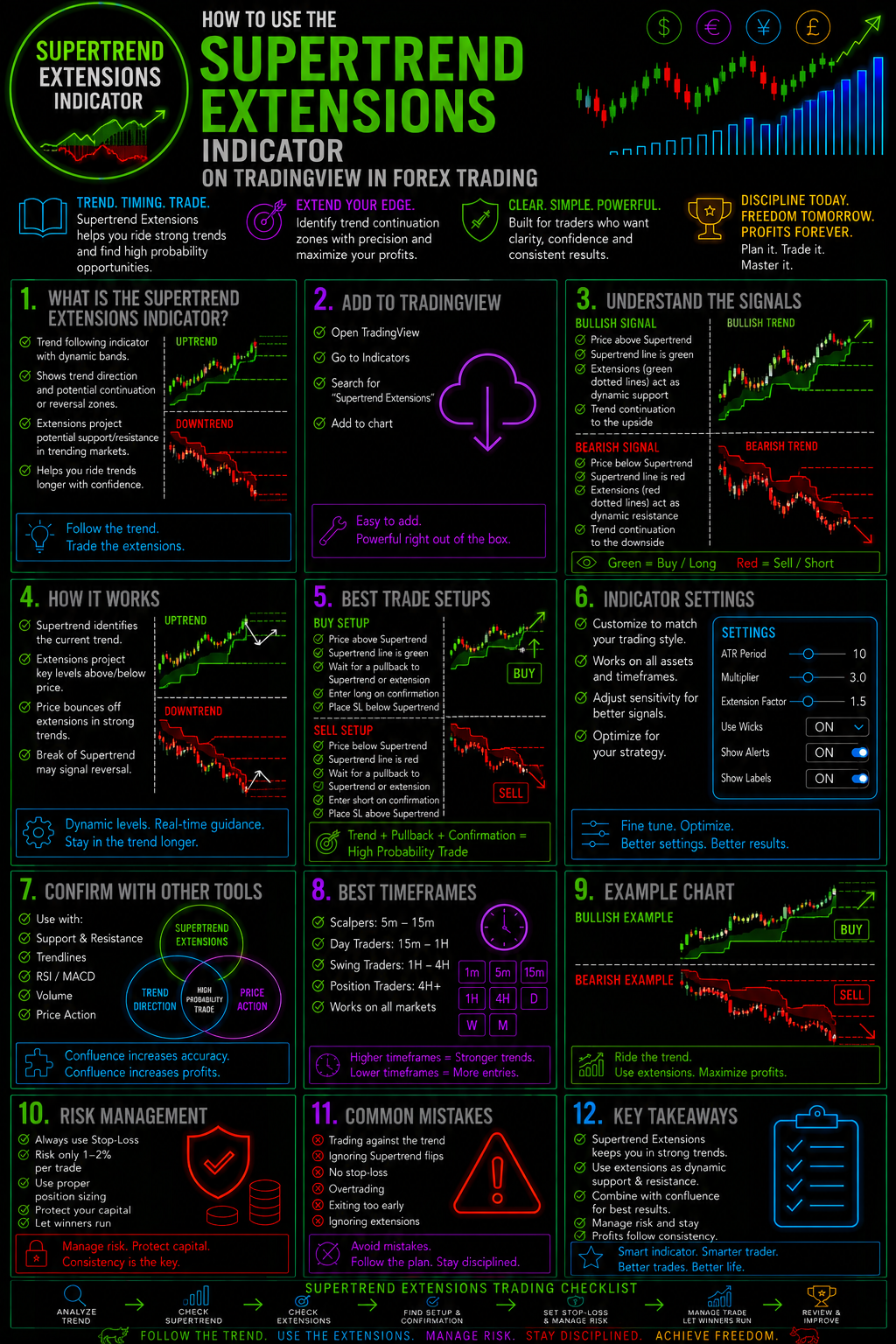
The Supertrend Extensions Indicator is a trend-following technical analysis tool designed to help traders identify the prevailing direction of a market.
It builds upon the traditional Supertrend concept by providing additional information that can help traders evaluate:
- Trend direction
- Potential bullish and bearish transitions
- Momentum
- Dynamic support and resistance
- Potential entry areas
- Potential exit areas
- Trend continuation
- Possible market reversals
For Forex traders, this can be particularly useful because currency markets frequently transition between trending, consolidating, and reversing conditions.
The objective isn't to predict every market move.
The objective is to establish a structured framework for determining whether the market is more likely to favor long trades, short trades, or staying out of the market altogether.
Why Use Supertrend Extensions In Forex Trading?
Forex traders have thousands of potential currency-market movements to analyze.
That creates a problem.
More information doesn't necessarily produce better trading decisions.
A strong trading system needs to simplify the market without oversimplifying it.
The Supertrend Extensions Indicator can help create that structure by giving traders a visual representation of the market's prevailing trend.
Instead of constantly asking:
"Should I buy or sell?"
A better question becomes:
"What is the market structure telling me right now?"
That shift in thinking can dramatically improve your trading process.
How To Add Supertrend Extensions To TradingView
TradingView makes it easy to add indicators to a Forex chart.
Open your preferred Forex currency pair.
Popular examples include:
Step 2: Select Indicators
At the top of your TradingView chart, select Indicators.
Step 3: Search For Supertrend Extensions
Enter:
Supertrend Extensions
into the TradingView indicator search.
Select the appropriate indicator from the available results.
Step 4: Add It To Your Chart
Once added, the indicator will appear directly on your Forex chart.
You can then adjust its settings according to your trading timeframe and strategy.
Understanding The Supertrend Extensions Indicator
The first step toward using any indicator successfully is understanding what it is attempting to communicate.
The Supertrend concept generally revolves around identifying whether price is trading within a bullish or bearish trend environment.
When the indicator changes direction, it can signal that market conditions have shifted.
However, traders should avoid treating every change as an automatic trade signal.Think Of The Indicator As A Market Filter
Instead of:
Signal → Trade
Use:
Signal → Confirmation → Trade
That small difference can help prevent many low-quality trades.
Supertrend Bullish Signals
A bullish Supertrend transition can indicate that market conditions are shifting toward the upside.
Traders may begin looking for:
- Higher highs
- Higher lows
- Bullish candlestick formations
- Breakouts above resistance
- Increasing momentum
- Confirmation from other indicators
The strongest opportunities often occur when several independent pieces of technical evidence point in the same direction.Example Bullish Trading Process
A potential bullish setup might look like:
Supertrend turns bullish → price breaks resistance → bullish candle confirms → momentum supports move → entry considered
The Supertrend signal becomes part of the decision-making process rather than the entire decision.
Supertrend Bearish Signals
The opposite process applies when the indicator transitions toward bearish conditions.
Traders may look for:
- Lower highs
- Lower lows
- Breakdowns below support
- Bearish candlestick patterns
- Weakening momentum
- Confirmation from other technical indicators
A potential bearish setup could develop as:
Supertrend turns bearish → support breaks → bearish price action confirms → momentum weakens → short entry considered
Again, confirmation matters.
The Biggest Mistake Traders Make With Supertrend
One of the biggest mistakes is assuming:
Green = Buy
and
Red = Sell
Trading is rarely that simple.
Indicators can produce false signals.
Markets can reverse suddenly.
Sideways markets can create multiple trend changes without producing a meaningful directional move.
This is why experienced traders don't simply ask whether an indicator has changed color.
They ask:"What is price actually doing?"
Use Price Action To Confirm Supertrend Signals
Price action should remain at the center of your analysis.
When Supertrend Extensions produces a potential signal, examine the underlying price structure.
Look for:
Bullish ConfirmationBearish Confirmation
- Higher highs
- Higher lows
- Breakout from consolidation
- Bullish engulfing candles
- Strong rejection of support
- Momentum expansion
- Lower highs
- Lower lows
- Breakdown from consolidation
- Bearish engulfing candles
- Rejection of resistance
- Momentum deterioration
The indicator provides information.
Price action provides context.
Supertrend Extensions + Support And Resistance
One of the most powerful ways to improve an indicator-based strategy is to combine it with established support and resistance levels.
Imagine the Supertrend turns bullish.
That's interesting.
But now imagine price is simultaneously breaking above a major resistance level.
That's much more interesting.
The combination of:
Bullish Supertrend + Resistance Breakout + Strong Price Action
can provide a substantially stronger technical setup than the Supertrend signal by itself.
The same concept applies to bearish trades.
Bearish Supertrend + Support Breakdown + Bearish Price Action
can create a more compelling short-side setup.
Using Multiple Timeframes
Forex traders should also consider the larger market picture.
A Supertrend signal on a five-minute chart doesn't exist in isolation.
The broader trend may be visible on the:
- 15-minute chart
- 1-hour chart
- 4-hour chart
- Daily chart
A multi-timeframe approach can help traders avoid fighting the larger trend.Example
Suppose the Daily and 4-Hour charts are bullish.
The 15-minute chart pulls back.
The Supertrend Extensions Indicator turns bearish temporarily.
Instead of immediately shorting, a trader could interpret the bearish signal as a short-term correction within a larger bullish environment.
That creates an entirely different trading decision.
A Simple Multi-Timeframe Supertrend Strategy
Here's a straightforward framework Forex traders can test.
Step 1 — Identify The Major Trend
Start with a higher timeframe.
Determine whether the market is primarily:
Bullish
Bearish
or
Sideways
Step 2 — Move To Your Trading Timeframe
Use your preferred execution timeframe.
Look for Supertrend confirmation in the direction of the larger trend.
Step 3 — Wait For Price Confirmation
Don't enter simply because the indicator changes direction.
Wait for price action to confirm.
Step 4 — Define Risk Before Entry
Determine:
- Entry
- Stop-loss
- Profit target
- Position size
- Maximum acceptable risk
Step 5 — Manage The Position
If the trend continues, allow the trade room to develop.
If the original setup becomes invalid, exit according to your predefined rules.
Supertrend Extensions For Forex Scalping
Scalpers may use Supertrend Extensions on lower timeframes to identify short-term directional movements.
Potential timeframes include:
- 1-minute
- 3-minute
- 5-minute
- 15-minute
However, lower timeframes also contain more market noise.
This means traders should be especially careful about:
- Spread
- Slippage
- False breakouts
- News events
- Low-liquidity periods
- Overtrading
A signal that looks excellent on a chart can behave very differently in live trading.
Supertrend Extensions For Swing Trading
Swing traders can use the same basic principles on higher timeframes.
For example:
4-Hour + Daily
can provide a useful framework for identifying larger Forex trends.
Swing traders may focus more heavily on:
- Major support and resistance
- Trend structure
- Breakouts
- Pullbacks
- Candlestick confirmation
- Risk-to-reward relationships
The objective is not to catch every move.
It's to identify high-quality directional opportunities.
Combining Supertrend With MACD
MACD can provide useful momentum and trend information alongside Supertrend.
For example:
Bullish Setup
Supertrend = Bullish
MACD = Bullish
Price Action = Bullish
Resistance = Broken
This creates multiple layers of confirmation.
Bearish Setup
Supertrend = Bearish
MACD = Bearish
Price Action = Bearish
Support = Broken
Again, multiple confirmations align.
If you're serious about understanding how momentum indicators can complement trend-following tools, explore the Forex Trading Unlocked MACD resources throughout the site.
Combining Supertrend With RSI
RSI can provide another layer of information.
Instead of using RSI simply as an overbought/oversold indicator, traders can examine:
- Momentum
- Divergence
- Trend strength
- Potential exhaustion
For example, a bullish Supertrend signal combined with improving RSI momentum may provide stronger confirmation than a Supertrend signal appearing while momentum is deteriorating.
Supertrend Extensions And Japanese Candlesticks
Candlestick analysis can add another important confirmation layer.
Watch for formations such as:
- Bullish Engulfing
- Bearish Engulfing
- Hammer
- Shooting Star
- Morning Star
- Evening Star
- Doji
- Rejection candles
The goal isn't to collect indicators.
It's to create confluence.
A Supertrend signal becomes more meaningful when it occurs at an important market level and is supported by convincing price action.
How To Build A Supertrend Forex Trading Setup
Here's a practical framework you can test.
BUY SETUP
1. Higher timeframe trend is bullish
↓
2. Supertrend Extensions turns bullish
↓
3. Price confirms bullish structure
↓
4. Price breaks or rejects a key level
↓
5. Momentum confirms
↓
6. Risk is defined
↓
7. Trade is executed
SELL SETUP
1. Higher timeframe trend is bearish
↓
2. Supertrend Extensions turns bearish
↓
3. Price confirms bearish structure
↓
4. Price breaks or rejects a key level
↓
5. Momentum confirms
↓
6. Risk is defined
↓
7. Trade is executed
Don't Ignore Risk Management
A profitable-looking strategy can still fail without proper risk management.
Before entering a Forex trade, know exactly:
Where am I wrong?
That question determines where your stop-loss belongs.
Don't place a stop-loss simply because an indicator tells you where to put it.
Consider:
- Market structure
- Support and resistance
- Recent swing highs/lows
- Volatility
- Currency pair characteristics
- Position size
Then calculate your position size based on the amount of capital you're willing to risk.
Avoid Trading Every Supertrend Signal
This deserves repeating.
You do not need to trade every signal.
Sometimes the highest-quality trading decision is:NO TRADE.
If the market is:
- Choppy
- Range-bound
- Extremely volatile
- Entering major economic news
- Producing conflicting signals
waiting may be the smartest decision.
Trading is not about activity.
It's about selectivity.
Supertrend Extensions Trading Checklist
Before entering a trade, ask:
- Is the higher-timeframe trend clear?
- Is the Supertrend direction aligned with that trend?
- Is price structure confirming the direction?
- Is there a meaningful support or resistance level?
- Has price broken or rejected that level?
- Is momentum supporting the trade?
- Is there enough room for the trade to reach its target?
- Where is the invalidation point?
- What is the risk-to-reward ratio?
- Am I entering because of a setup—or because I feel I need to trade?
If several answers are "no," stand aside.
Turn TradingView Into A Complete Forex Analysis System
The real power comes from combining tools.
TradingView can become your central analysis platform for:
- Trend analysis
- Support and resistance
- Candlestick analysis
- MACD
- RSI
- Supertrend
- Fibonacci
- Volume-based analysis
- Multi-timeframe analysis
- Trade planning
And Forex Trading Unlocked can help you go much deeper.Continue Learning:
[Explore Forex Trading Strategies]
Discover additional technical strategies and trading concepts designed to help you build a more complete Forex trading process.
[Learn Japanese Candlestick Patterns]
Learn how price action can help confirm potential reversals, breakouts, and continuation patterns.
[Master MACD Forex Trading]
Explore MACD signals, crossovers, divergence, momentum, and trend confirmation.
[Explore Forex Risk Management]
Because identifying a great setup means little if you don't know how much to risk.
[Learn How To Trade Forex]
Build your understanding from the fundamentals through advanced technical analysis.
Want To Go Beyond Indicators?
Indicators are tools.
Your trading process is the system.
The strongest traders don't rely on a single flashing signal to make decisions.
They build a repeatable process around:
Market Structure + Trend + Price Action + Momentum + Risk Management
That's where Forex Trading Unlocked can take you further.
The Forex Trading Unlocked Advantage
If you're serious about becoming a more disciplined Forex trader, don't stop with one indicator.
Explore the growing library of Forex trading education, TradingView indicator guides, technical analysis strategies, Japanese candlestick education, market analysis, and professional trading resources available throughout Forex Trading Unlocked.
Don't Just Watch The Market.
Learn To Read It.
Explore Forex Trading Unlocked →
Build Your Trading Knowledge →
Discover Our Trading Resources →
Join The Forex Trading Unlocked Community →
Final Thoughts
The Supertrend Extensions Indicator can be a valuable addition to a Forex trader's TradingView toolkit.
But the goal isn't to find a magical indicator that predicts the market.
There isn't one.
The real opportunity comes from learning how to combine trend information with price action, market structure, momentum, support and resistance, multi-timeframe analysis, and disciplined risk management.
Use Supertrend Extensions as part of that process.
Test it.
Backtest it.
Forward-test it.
Learn when it performs well—and when it doesn't.
Then develop rules that fit your trading style, timeframe, risk tolerance, and objectives.
Because successful Forex trading isn't about finding more signals.
It's about learning which signals deserve your attention.
SEO FAQ: Supertrend Extensions Indicator Forex Trading
What is the Supertrend Extensions Indicator?
The Supertrend Extensions Indicator is a TradingView technical analysis tool designed to help traders identify market trends, potential directional changes, and possible trading opportunities.
How do you use Supertrend Extensions in Forex trading?
Use the indicator to identify potential trend direction, then confirm signals with price action, market structure, support and resistance, momentum, and risk management.
Is Supertrend Extensions good for Forex?
It can be useful for Forex trend analysis, but no indicator works perfectly in every market condition. Traders should test the indicator and use appropriate confirmation and risk-management rules.
Can Supertrend Extensions be used for scalping?
Yes. Traders can use it on lower timeframes, although lower-timeframe trading generally produces more market noise and potentially more false signals.
Can Supertrend Extensions be used for swing trading?
Yes. Higher timeframes such as the 4-hour and daily charts can be used to analyze broader Forex trends and potential swing-trading opportunities.
Should you trade every Supertrend signal?
No. Supertrend signals should be evaluated in the context of market structure, price action, volatility, support and resistance, and the trader's risk-management rules.
What indicators work well with Supertrend?
Traders may combine Supertrend with tools such as MACD, RSI, moving averages, Fibonacci levels, support and resistance, and Japanese candlestick analysis.
Does Supertrend predict Forex reversals?
Supertrend can identify potential changes in trend direction, but it does not reliably predict every market reversal. Confirmation and proper risk management remain essential.
Your Next Move
Don't stop at the indicator.
Learn the market.
Understand the setup.
Control the risk.
Execute the plan.
That's how you turn TradingView from a charting platform into a serious Forex trading laboratory.
👉 “Get Instant Access (Check Your Email)”
💥 IMPORTANT: One Last Step Required
After you enter your email, check your inbox (or spam folder) for a confirmation email.
👉 Click the confirmation link so I can send you your free Forex training.
⚠️ If you don’t confirm, I can’t send you anything.
👉 “⚠️ Access expires if not confirmed within 24 hours minutes.”
👉 “Takes 10 seconds. Instant access after email confirmation.”