How To Use The Trend State Signals Indicator On TradingView In Forex Trading
How To Use The Trend State Signals Indicator On TradingView In Forex Trading
Stop Guessing The Trend. Start Reading Market State.
Forex traders don't lose money because they can't find enough indicators.
They lose money because they often enter before the market has clearly established its direction.
The Trend State Signals Indicator on TradingView can help traders organize what the market is doing by focusing attention on its current trend state and potential directional shifts.
Instead of chasing every candle, traders can use trend-state information as part of a structured process for identifying bullish conditions, bearish conditions, changing momentum, and potential trade opportunities.
And that's the real objective.
You don't need more noise on your chart. You need better information.
In this guide, we'll show you how to use the Trend State Signals Indicator in Forex trading, how to interpret its signals, where it can fit into a trading strategy, and how to combine it with price action, support and resistance, momentum, and risk management.
What Is The Trend State Signals Indicator?
The Trend State Signals Indicator is a TradingView-based technical analysis tool designed to help traders recognize the prevailing state of a market.
Rather than looking at one isolated price candle and trying to predict what happens next, the trader can use trend-state information to help determine whether the market is displaying conditions associated with:
- Bullish movement
- Bearish movement
- Trend continuation
- Potential trend changes
- Weakening or changing market conditions
- Possible entry and exit opportunities
The important distinction is this:
A signal is not a trade.
A signal gives you information.
Your trading strategy determines what you do with that information.
That distinction can dramatically improve how you approach technical indicators.
Why Trend State Matters In Forex Trading
The Forex market constantly moves between different conditions.
Sometimes price trends aggressively.
Sometimes it trends slowly.
Sometimes the market consolidates.
And sometimes a seemingly strong trend reverses before inexperienced traders realize what happened.
This creates one of the biggest challenges in Forex:Knowing when the market is actually trending.
A trader who understands market state can approach each environment differently.
In a bullish environment, the trader may concentrate on long setups.
In a bearish environment, the trader may concentrate on short setups.
During uncertain or sideways conditions, the trader may become more selective rather than forcing trades.
That is where a trend-state indicator can become useful.
It can provide another layer of information between what price is doing now and what you are willing to risk money on.
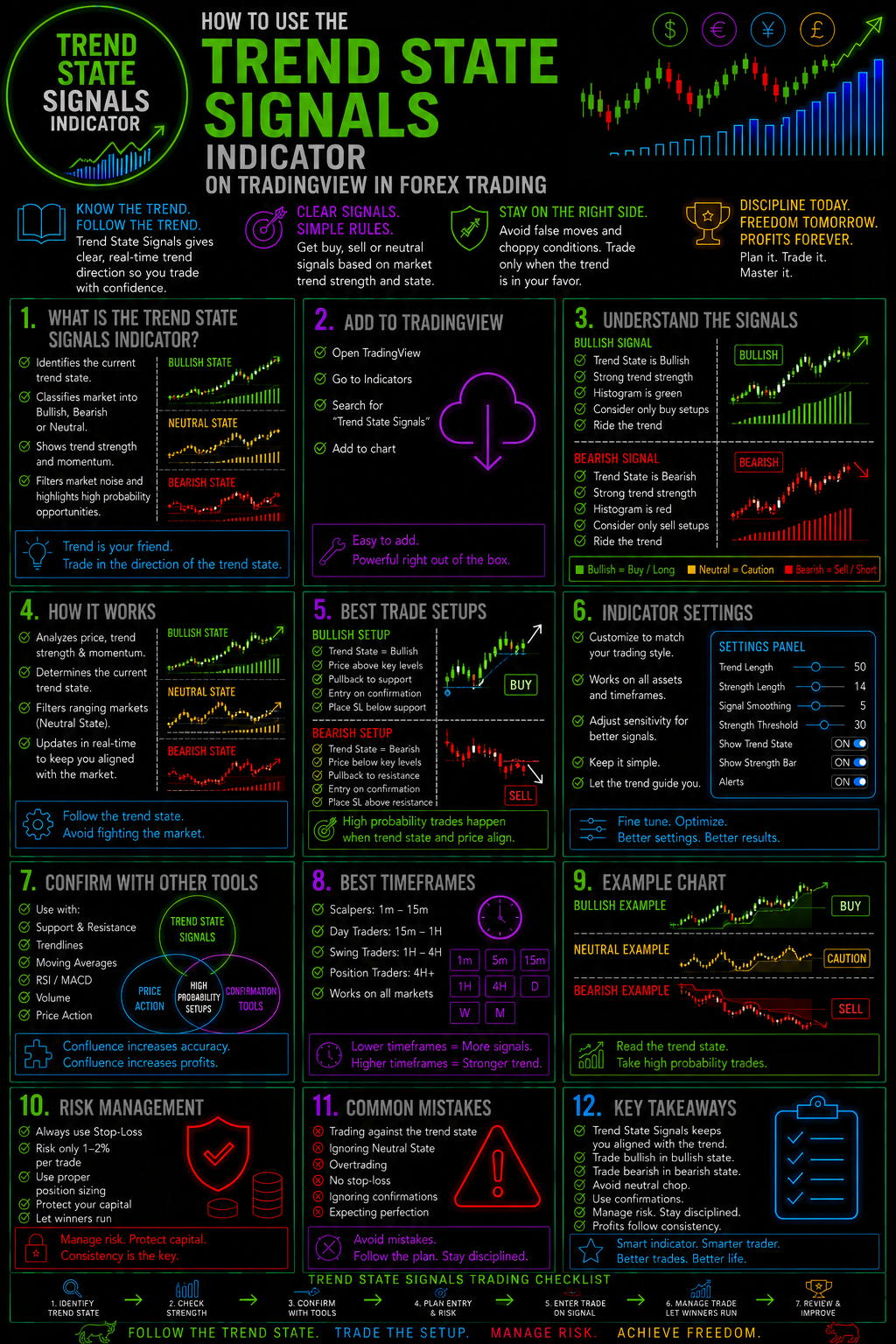
How To Add The Trend State Signals Indicator To TradingView
Adding an indicator to TradingView is straightforward.
Open the TradingView chart for the Forex pair you want to analyze.
Then:
- Open the Indicators menu.
- Search for Trend State Signals.
- Select the appropriate indicator.
- Add it to your chart.
- Review the indicator's visual signals and settings.
- Adjust the configuration according to your trading timeframe and strategy.
Before changing settings, spend some time observing how the indicator behaves on historical price action.
Don't immediately optimize it until every historical signal appears perfect.
That's a common trap.
The goal isn't to create an indicator that looks amazing in hindsight.
The goal is to develop a repeatable process that can be applied to future market conditions.
How To Read Trend State Signals
The first step is learning to interpret the indicator in the context of price.
When the indicator suggests a bullish state, traders can begin looking for evidence that buyers are controlling the market.
When bearish conditions appear, traders can look for evidence that sellers are gaining control.
But don't stop there.
Ask three questions:
1. What Is Price Doing?
Is price making higher highs and higher lows?
Is it making lower highs and lower lows?
Or is price trapped inside a range?
2. Where Is The Signal Appearing?
A bullish signal in the middle of a major resistance zone is very different from a bullish signal appearing after price breaks important resistance.
Likewise, a bearish signal directly above major support deserves more caution.
3. What Is The Higher-Timeframe Trend?
A signal on a five-minute chart can look attractive while the four-hour chart is strongly bearish.
This is why experienced traders don't analyze signals in isolation.
Context matters.
Trend State Signals + Price Action
One of the strongest ways to use any trend indicator is to combine it with price action.
Instead of thinking:
"The indicator says buy, therefore I buy."
Think:
"The indicator is showing bullish conditions. Now, does price action give me a reason to participate?"
That is a much stronger approach.
Look for confirmation through:
- Higher highs and higher lows
- Breakouts
- Pullbacks
- Support and resistance
- Trendline breaks
- Candlestick reversal patterns
- Momentum confirmation
- Retests of broken levels
The indicator becomes part of the decision-making process rather than the entire decision-making process.
Using The Indicator With Support And Resistance
Support and resistance can dramatically change the quality of a trading signal.
Imagine EURUSD is approaching a major resistance level.
The Trend State Signals Indicator turns bullish.
Does that automatically mean you should buy?
Not necessarily.
Price could encounter sellers at resistance and reverse.
Now consider another scenario.
EUR/USD breaks above significant resistance.
The indicator shifts bullish.
Price retests the breakout area and holds.
The market begins creating higher highs and higher lows.
Now the bullish signal has substantially more context behind it.
This is the type of confluence Forex traders should look for.Indicator + Price Structure + Key Level
That's far more powerful than blindly following an indicator.
Trend State Signals For Bullish Forex Setups
A bullish setup can begin when the market transitions from weakness or consolidation into stronger bullish conditions.
A trader could look for:
Step 1: Trend State Signals indicates bullish conditions.
Step 2: Price confirms bullish structure.
Step 3: Price holds or breaks an important support/resistance area.
Step 4: A pullback creates a potential entry opportunity.
Step 5: Risk is defined before entering.
Step 6: The trade is managed according to a predetermined plan.
The objective isn't to enter simply because the indicator changes state.
The objective is to use the state change as a market-filtering tool.
Trend State Signals For Bearish Forex Setups
The same concept works in reverse.
A bearish setup may begin when the market transitions into bearish conditions.
A trader can then look for:
- Lower highs
- Lower lows
- Failed rallies
- Resistance rejection
- Bearish candlestick patterns
- Breaks of support
- Retests of broken support
- Momentum confirmation
When several independent pieces of evidence point in the same direction, the setup becomes easier to evaluate.
Again, the indicator isn't predicting the future.
It is helping organize the information already developing in the market.
The Multi-Timeframe Advantage
One of the most powerful improvements you can make to your Forex analysis is learning to think across multiple timeframes.
For example:Higher Timeframe
Determine the broader market direction.Intermediate Timeframe
Identify the developing trend and important levels.Lower Timeframe
Look for the actual trade setup.
This creates a hierarchy.
Direction → Structure → Entry
Instead of allowing a short-term indicator signal to dictate your entire trade, you can use the Trend State Signals Indicator as one component of a multi-timeframe analysis.
Don't Make This Common Trading Mistake
There is a temptation to believe that adding more indicators automatically produces better trades.
It doesn't.
Five indicators can give you five different opinions.
Your chart becomes cluttered.
Your decisions become slower.
And eventually, you stop trading your strategy and start trading your indicators.
That's backwards.
A professional approach is about finding confluence, not collecting indicators.
Use the Trend State Signals Indicator because it contributes something useful to your analysis.
Don't use it simply because it is another signal generator.
Trend State Signals Indicator Trading Strategy
Here's a simple framework you can use to begin testing the indicator.The Trend Confirmation Framework
Step 1 — Identify Market Direction
Start with the higher timeframe.
Is the market bullish, bearish, or ranging?
Step 2 — Identify Important Price Levels
Mark support, resistance, previous highs, previous lows, and major breakout areas.
Step 3 — Observe The Trend State
Look at what the Trend State Signals Indicator is communicating.
Is it aligned with your broader market analysis?
Step 4 — Wait For Price Confirmation
Don't chase the first signal.
Wait for price to demonstrate that the market is actually behaving in the anticipated direction.
Step 5 — Define Risk
Determine your stop-loss location before entering the trade.
Step 6 — Define The Trade
Know your entry, stop, target, and risk-to-reward relationship.
Step 6 — Define The Trade
Know your entry, stop, target, and risk-to-reward relationship.
What Timeframe Should You Use?
There isn't one universally perfect timeframe.
Your timeframe should match your trading style.Scalpers
Lower timeframes can provide more frequent signals, but they also contain considerably more market noise.Day Traders
Intermediate timeframes can provide a balance between signal frequency and market structure.Swing Traders
Higher timeframes can help identify broader trends and potentially reduce short-term market noise.
The key is consistency.
If you constantly switch timeframes looking for the signal you want to see, you're not improving your analysis.
You're searching for confirmation.
How To Avoid False Signals
No trend indicator can eliminate false signals.
Markets don't move in perfectly predictable patterns.
A trend can reverse.
A breakout can fail.
Momentum can disappear.
A signal can arrive late.
That's why risk management remains essential.
Use additional confirmation such as:
- Market structure
- Support and resistance
- Candlestick patterns
- Momentum
- Volume-related tools where appropriate
- Higher-timeframe direction
- Breakout and retest behavior
The more independent evidence supporting a trade, the more informed the decision becomes.
But remember:
More confirmation does not mean certainty.
There is no certainty in Forex trading.
There are only probabilities and risk.
Trend State Signals And Forex Risk Management
This is where many traders get it wrong.
They spend hours searching for the perfect indicator and almost no time developing a risk-management framework.
A great signal with terrible risk management can still produce terrible results.
Before every trade, know:
Where am I entering?
Where am I wrong?
How much am I risking?
Where is my potential target?
Does the potential reward justify the risk?
If you cannot answer those questions before entering the trade, the indicator isn't the problem.
The trading process is.
Build Your Forex Trading System Around Confluence
The Trend State Signals Indicator should not exist in isolation.
Think of your trading process as a series of filters.
Filter #1 — Market Direction
What is the larger trend?
Filter #2 — Market Structure
Is price creating a bullish, bearish, or ranging structure?
Filter #3 — Key Levels
Where are the important support and resistance zones?
Filter #4 — Trend State
What is the indicator communicating?
Filter #5 — Entry Confirmation
Has price actually provided an actionable setup?
Filter #6 — Risk
Does the trade meet your risk-management rules?
If the setup passes all six filters, you have something worth evaluating.
If it fails several filters, walk away.
The best trade you make today may be the trade you refuse to take.
Take Your Forex Analysis Beyond One Indicator
The Trend State Signals Indicator can be useful.
But your real advantage comes from knowing how to interpret price, trend, momentum, structure, and risk together.
That's exactly why Forex Trading Unlocked goes beyond individual indicators.
If you're serious about becoming a more disciplined Forex trader, continue exploring the strategies, technical-analysis guides, TradingView indicators, candlestick education, and market-structure resources available throughout Forex Trading Unlocked.
Don't build your trading around one signal. Build your trading around a process.
Ready To Upgrade Your Forex Trading?
You can spend the next year jumping from indicator to indicator.
Or you can start building a structured trading approach.
Forex Trading Unlocked is designed to help traders move beyond random entries and toward a more organized understanding of:
- Forex market structure
- Technical analysis
- Japanese candlestick patterns
- Trend identification
- Momentum
- Support and resistance
- Trade execution
- Risk management
- Trading psychology
- TradingView tools and indicators
The goal isn't to find a magic indicator.
The goal is to become the trader who knows what to do when the market changes.Explore More Forex Trading Strategies
Continue learning with our comprehensive Forex trading education and discover additional strategies designed to help you analyze the market with greater clarity.
[EXPLORE FOREX TRADING STRATEGIES →]Master Japanese Candlestick Patterns
Learn how high-probability candlestick patterns can help you understand potential shifts in market sentiment and price direction.
[LEARN JAPANESE CANDLESTICK PATTERNS →]Discover More TradingView Indicators
Don't stop with one indicator. Explore our growing library of TradingView indicator guides and learn how different tools can fit into a complete Forex trading process.
[EXPLORE TRADINGVIEW INDICATORS →]Want A More Complete Trading System?
If you're ready to move beyond individual indicators and build a repeatable approach to market analysis, explore the Forex Trading Unlocked training and educational resources.
[DISCOVER FOREX TRADING UNLOCKED →]
Final Thoughts
The Trend State Signals Indicator can help Forex traders identify changing market conditions and organize their analysis around prevailing trend states.
But the smartest way to use it isn't to blindly follow every signal.
Use it as part of a larger framework.
Trend direction.
Market structure.
Key levels.
Price action.
Confirmation.
Risk management.
When those elements begin working together, your chart becomes more than a collection of indicators.
It becomes a decision-making framework.
And that's the difference between following signals and learning how to trade.
Forex Trading Disclaimer
Forex trading involves substantial risk and is not suitable for every trader. Technical indicators are analytical tools and do not guarantee profitable results. Always conduct your own research, use appropriate risk management, and never risk more than you can afford to lose.
👉 “Get Instant Access (Check Your Email)”
💥 IMPORTANT: One Last Step Required
After you enter your email, check your inbox (or spam folder) for a confirmation email.
👉 Click the confirmation link so I can send you your free Forex training.
⚠️ If you don’t confirm, I can’t send you anything.
👉 “⚠️ Access expires if not confirmed within 24 hours minutes.”
👉 “Takes 10 seconds. Instant access after email confirmation.”