How To Use The Triple Confluence Navigator Indicator On TradingView In Forex Trading
How To Use The Triple Confluence Navigator Indicator On TradingView In Forex Trading
Stop guessing where the market may be headed. Start looking for confluence.
Successful Forex trading isn't about finding one magical indicator that predicts every market move. It's about building a repeatable process that brings multiple pieces of market information together before you commit capital.
The Triple Confluence Navigator Indicator on TradingView is designed around that exact concept.
When properly incorporated into a Forex trading strategy, the indicator can help traders organize market information, identify potential trade opportunities, and look for situations where multiple conditions align.
But here's the important part:
The indicator should not replace your trading plan. It should strengthen it.
This guide shows you how to use the Triple Confluence Navigator Indicator on TradingView, how to interpret its signals, how to combine it with price action and market structure, and how to turn confluence into a more disciplined Forex trading process.
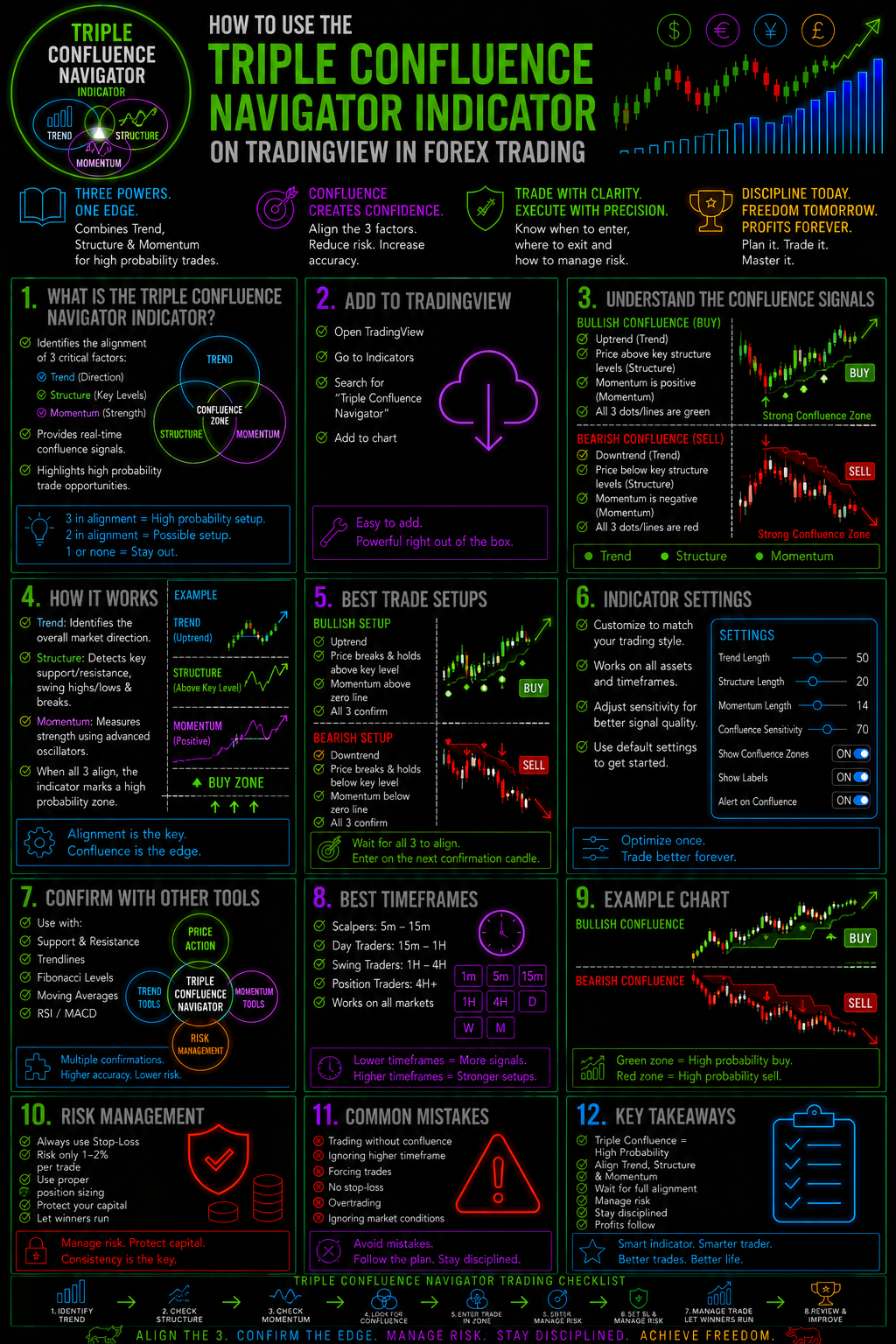
What Is The Triple Confluence Navigator Indicator?
The Triple Confluence Navigator is a TradingView indicator designed to help traders evaluate the market through multiple confirming conditions rather than relying on a single signal.
The basic philosophy is simple:
One signal can be misleading. Multiple confirming signals can create a stronger trading setup.
In Forex trading, markets are constantly moving through trends, consolidations, breakouts, retracements and reversals.
A trader who enters simply because an indicator flashes BUY or SELL may be entering without understanding the larger market environment.
The Triple Confluence Navigator gives traders another way to approach the chart.
Instead of asking:
"Is this a BUY signal?"
A better question becomes:
"Are multiple conditions aligning to support this trade?"
That distinction can dramatically improve the way you analyze potential setups.
Why Confluence Matters In Forex Trading
Forex markets can produce an enormous amount of noise.
Price may temporarily move against the prevailing trend. Breakouts can fail. Support and resistance can be violated. Momentum can disappear quickly.
This is why experienced traders often look for confluence.
Confluence occurs when several independent or complementary factors support the same trading idea.
For example:
- The higher-timeframe trend is bullish.
- Price pulls back toward support.
- Momentum begins turning higher.
- The Triple Confluence Navigator confirms bullish conditions.
- A bullish Japanese candlestick pattern appears.
Now you aren't trading because of one isolated signal.
You're trading because several pieces of information are pointing in the same direction.
That is the power of confluence.
How To Add The Triple Confluence Navigator To TradingView
TradingView makes it easy to add indicators to your charts.
Once you have located the Triple Confluence Navigator Indicator, add it to the Forex chart you are analyzing.
Start with a clean chart.
Avoid immediately adding ten additional indicators.
The objective is to understand what the Triple Confluence Navigator is showing you before creating unnecessary visual clutter.
Start With These Questions:
1. What is the current market trend?
Is price generally moving higher, lower, or sideways?
2. Where is price located?
Is price approaching support, resistance, a previous swing high, a previous swing low, or another important technical level?
3. What is the indicator communicating?
Are its conditions supporting bullish or bearish market behavior?
4. Does price action agree?
This is critical.
You don't want to blindly follow an indicator.
You want to determine whether the market itself is confirming the signal.
The Triple Confluence Trading Process
A powerful way to use the indicator is to create a simple confirmation process.Step 1: Identify Market Direction
Begin by determining the broader direction of the currency pair.
Look at the structure of price.
An uptrend generally produces:
Higher Highs + Higher Lows
A downtrend generally produces:
Lower Highs + Lower Lows
If the market is clearly trending upward, bullish setups deserve greater attention.
If the market is trending downward, bearish opportunities deserve greater attention.
If the market is moving sideways, be more selective.
Step 2: Locate Important Price Levels
Next, identify areas where price may react.
Look for:
- Support
- Resistance
- Previous swing highs
- Previous swing lows
- Breakout zones
- Retracement areas
- Trendlines
- Major psychological price levels
This creates the market context surrounding the indicator signal.
A bullish signal occurring directly above meaningful support may be considerably more interesting than the same signal appearing randomly in the middle of a range.
Step 3: Wait For Confluence
This is where the Triple Confluence Navigator becomes particularly useful.
Rather than treating every signal equally, look for situations where the indicator agrees with the market structure.
For example:
Bullish Setup
- Higher-timeframe trend is bullish.
- Price pulls back.
- Price reaches a support zone.
- Bullish confluence develops.
- Price begins showing bullish rejection.
- Entry occurs only after confirmation.
The objective isn't to predict the exact bottom.
The objective is to wait until the probability of a bullish continuation appears more attractive.
Step 4: Look For Price Action Confirmation
Indicators are tools.
Price is the market.
This is why Japanese candlestick analysis can be extremely useful alongside indicator-based trading.
Look for patterns such as:
- Bullish engulfing patterns
- Bearish engulfing patterns
- Hammer formations
- Shooting stars
- Pin bars
- Strong rejection candles
- Breakout candles
- Continuation candles
A Triple Confluence Navigator signal combined with meaningful price action can provide a much stronger trading narrative than either element alone.
Step 5: Define Your Entry Before You Trade
Don't enter simply because everything "looks good."
Define the exact conditions required for your trade.
For example:Long Trade
Trend: Bullish
Location: Support
Indicator: Bullish confirmation
Price Action: Bullish reversal
Entry: Confirmation above trigger level
Stop: Below invalidation area
Target: Next significant resistance
The same process can be reversed for short trades.
This transforms trading from emotional decision-making into a structured process.
Triple Confluence Navigator Forex Buy Setup
Imagine EUR/USD is trending higher.
Price begins pulling back toward a previously established support area.
Instead of immediately buying the dip, you wait.
The Triple Confluence Navigator begins providing bullish confirmation.
Price holds support.
A bullish candlestick pattern forms.
The market then begins breaking above the short-term resistance created during the pullback.
Now several elements are aligned:
Trend + Location + Indicator + Price Action
That is a much more compelling setup than simply buying because an indicator generated a signal.
Triple Confluence Navigator Forex Sell Setup
The same principle works in reverse.
Imagine GBP/USD is trending lower.
Price rallies into a resistance zone.
The market begins showing signs of rejection.
The Triple Confluence Navigator provides bearish confirmation.
A bearish candlestick pattern develops.
Price then breaks below the short-term support created during the failed rally.
The trader now has multiple factors supporting the bearish thesis.
Again:
Trend + Location + Indicator + Price Action
The goal is not certainty.
The goal is better-qualified trade selection.
Using Multiple Timeframes With The Triple Confluence Navigator
One of the most powerful ways to improve indicator-based trading is through multiple-timeframe analysis.
Instead of looking at only one chart, examine the market from several perspectives.
For example:
Higher Timeframe
Use the daily or 4-hour chart to determine the broader market structure.
Trading Timeframe
Use the 1-hour or 30-minute chart to locate the setup.
Entry Timeframe
Use a lower timeframe to refine the actual entry if appropriate for your trading style.
This creates a hierarchy:
Direction → Setup → Entry
A lower-timeframe bullish signal becomes more interesting when it aligns with a bullish higher-timeframe environment.
Likewise, a bearish lower-timeframe setup may carry greater significance when the higher timeframe is also bearish.
Don't Make The Most Common Indicator Trading Mistake
One of the biggest mistakes traders make is treating an indicator as a prediction machine.
No indicator can eliminate market uncertainty.
The Triple Confluence Navigator should not be viewed as:
"BUY means price must go up."
Instead, think:
"This signal may be identifying conditions worth investigating."
That mindset matters.
The trader remains responsible for:
- Market analysis
- Risk management
- Trade selection
- Position sizing
- Entry execution
- Stop-loss placement
- Profit targets
- Trade management
The indicator is part of the process—not the entire process.
Risk Management Still Comes First
Even an excellent-looking setup can fail.
That means risk management must remain at the center of your trading strategy.
Before entering a trade, determine:
Where is the trade invalidated?
How much capital am I willing to risk?
Where is my stop-loss?
Where is my profit target?
Does the potential reward justify the risk?
Never increase your position size simply because multiple indicators appear to agree.
Confluence does not eliminate risk.
It helps you filter opportunities.
Triple Confluence Navigator And Risk/Reward
Suppose a potential trade offers:
Risk: 25 pips
Potential Reward: 75 pips
That produces a:
1:3 Risk-to-Reward Ratio
The trade does not need to be perfect.
A disciplined strategy can potentially remain viable even when some trades lose, provided risk is controlled and the overall strategy has a positive expectancy.
This is why the goal should never be:
"How can I win every trade?"
The better question is:
"How can I consistently take high-quality trades while controlling my downside?"
When NOT To Trade The Triple Confluence Navigator
Knowing when to stay out of the market is just as important as knowing when to enter.
Be cautious when:
- The market is extremely choppy.
- Price is trapped inside a narrow range.
- Signals repeatedly reverse direction.
- Major support and resistance are too close together.
- Risk/reward is unattractive.
- You cannot clearly identify the invalidation point.
- You are entering simply because you fear missing the move.
- Multiple signals conflict with one another.
Sometimes the highest-quality trading decision is:
NO TRADE.
Capital preservation is part of professional trading.
Triple Confluence Navigator Trading Checklist
Before entering a trade, ask yourself:
Market Structure
- Is the market trending or ranging?
- What is the higher-timeframe direction?
- Are higher highs/higher lows or lower highs/lower lows present?
Location
- Is price near meaningful support or resistance?
- Is price entering a logical trade location?
Confluence
- Is the Triple Confluence Navigator supporting the setup?
- Are other technical factors supporting the same direction?
Price Action
- Is there a confirming candlestick pattern?
- Has price demonstrated rejection or continuation?
Risk
- Where is the trade invalidated?
- Where is the stop-loss?
- Where is the target?
- Is the risk/reward acceptable?
Execution
- Am I following my trading plan?
- Am I entering because the setup is valid—or because I want to be in a trade?
If you cannot answer these questions clearly, wait.
Take Your Forex Trading Beyond A Single Indicator
The real advantage of learning indicators isn't collecting more indicators.
It's learning how to build a complete trading system.
The Triple Confluence Navigator can become one component of that system.
Combine it with:
Market Structure
Japanese Candlestick Patterns
Support & Resistance
Trend Analysis
Multiple-Timeframe Analysis
Risk Management
Trade Psychology
The result is a much more comprehensive approach to Forex trading.
And that's exactly where serious traders should focus.
Want To Become A More Complete Forex Trader?
If you're learning how to use TradingView indicators, don't stop with one tool.
Explore more of our Forex Trading Unlocked education and discover strategies, indicators, market analysis techniques and trading concepts designed to help you build a stronger trading foundation.Continue Learning:
Forex Trading For Beginners
Learn the essential concepts every new Forex trader needs to understand.
Japanese Candlestick Patterns
Discover how price action can reveal potential market reversals and continuation opportunities.
Forex Risk Management
Learn why controlling risk is more important than chasing the next winning trade.
MACD Forex Trading Strategy
Explore one of the most widely used momentum and trend-following tools.
Support & Resistance Trading
Learn how important price levels can help identify potential trade locations.
Multiple-Timeframe Forex Trading
See how traders can combine higher-timeframe market direction with lower-timeframe entries.
TradingView Forex Indicators
Explore more TradingView indicators and learn how they can be incorporated into a structured trading strategy.
Ready To Take Your Trading Further?
Reading about Forex trading is only the beginning.
The traders who improve are the ones who develop a process, test that process, manage risk and continue learning.
Forex Trading Unlocked is built to help you do exactly that.
Explore our Forex education, trading strategies, TradingView indicators and advanced market-analysis resources.Don't Just Trade The Market. Learn How To Read It.
Explore Forex Trading Unlocked →
Frequently Asked Questions
What is the Triple Confluence Navigator Indicator?
The Triple Confluence Navigator is a TradingView indicator designed to help traders evaluate multiple market conditions and identify areas where several technical factors may align.
Can beginners use the Triple Confluence Navigator?
Yes. Beginners can use the indicator as part of a structured learning process, but they should first understand basic concepts such as market structure, support and resistance, risk management and price action.
Does the Triple Confluence Navigator predict Forex prices?
No indicator can reliably predict future Forex prices. The Triple Confluence Navigator should be treated as an analytical tool that helps identify potential conditions and setups—not as a guarantee of future market direction.
What Forex pairs can I trade with the indicator?
The indicator can be incorporated into analysis of major, minor and other currency pairs available on TradingView, subject to the characteristics and liquidity of the individual market.
What timeframe should I use?
There is no single best timeframe. The appropriate timeframe depends on your trading style. Consider using multiple timeframes to understand the broader trend, identify the setup and refine your entry.
Should I use other indicators with it?
Potentially. Rather than adding indicators simply to create more signals, focus on complementary tools such as market structure, support and resistance, momentum and price action.
Is the Triple Confluence Navigator a complete Forex trading system?
No. An indicator should be considered one component of a broader trading methodology. A complete trading approach should also address entries, exits, position sizing, risk management and trading psychology.
Can the indicator be used for scalping?
It may be incorporated into a scalping strategy, but lower-timeframe trading can generate substantially more market noise and requires disciplined execution and risk management.
Final Thought
The best indicator isn't necessarily the one that gives you the most signals.
It's the one you understand well enough to incorporate into a disciplined trading process.
The Triple Confluence Navigator can help you look beyond isolated BUY and SELL signals and instead focus on the bigger picture:
Trend. Location. Confluence. Price Action. Risk.
Master those concepts, and you're no longer simply reacting to indicators.
You're building a trading process.
👉 “Get Instant Access (Check Your Email)”
💥 IMPORTANT: One Last Step Required
After you enter your email, check your inbox (or spam folder) for a confirmation email.
👉 Click the confirmation link so I can send you your free Forex training.
⚠️ If you don’t confirm, I can’t send you anything.
👉 “⚠️ Access expires if not confirmed within 24 hours minutes.”
👉 “Takes 10 seconds. Instant access after email confirmation.”