How To Use The Two-Pole Oscillator Indicator On TradingView In Forex Trading
Stop guessing when forex momentum is changing. Learn how to use the Two-Pole Oscillator Indicator on TradingView to help identify momentum shifts, potential trend changes, and higher-probability trade setups.
The forex market can move quickly. A setup that looks attractive one minute can lose momentum the next.
The Two-Pole Oscillator gives traders another way to evaluate what is happening beneath price action—helping you analyze momentum and potential market transitions without relying on price alone.Learn The Indicator. Understand The Signal. Improve Your Trading Decisions.
[LEARN HOW IT WORKS]
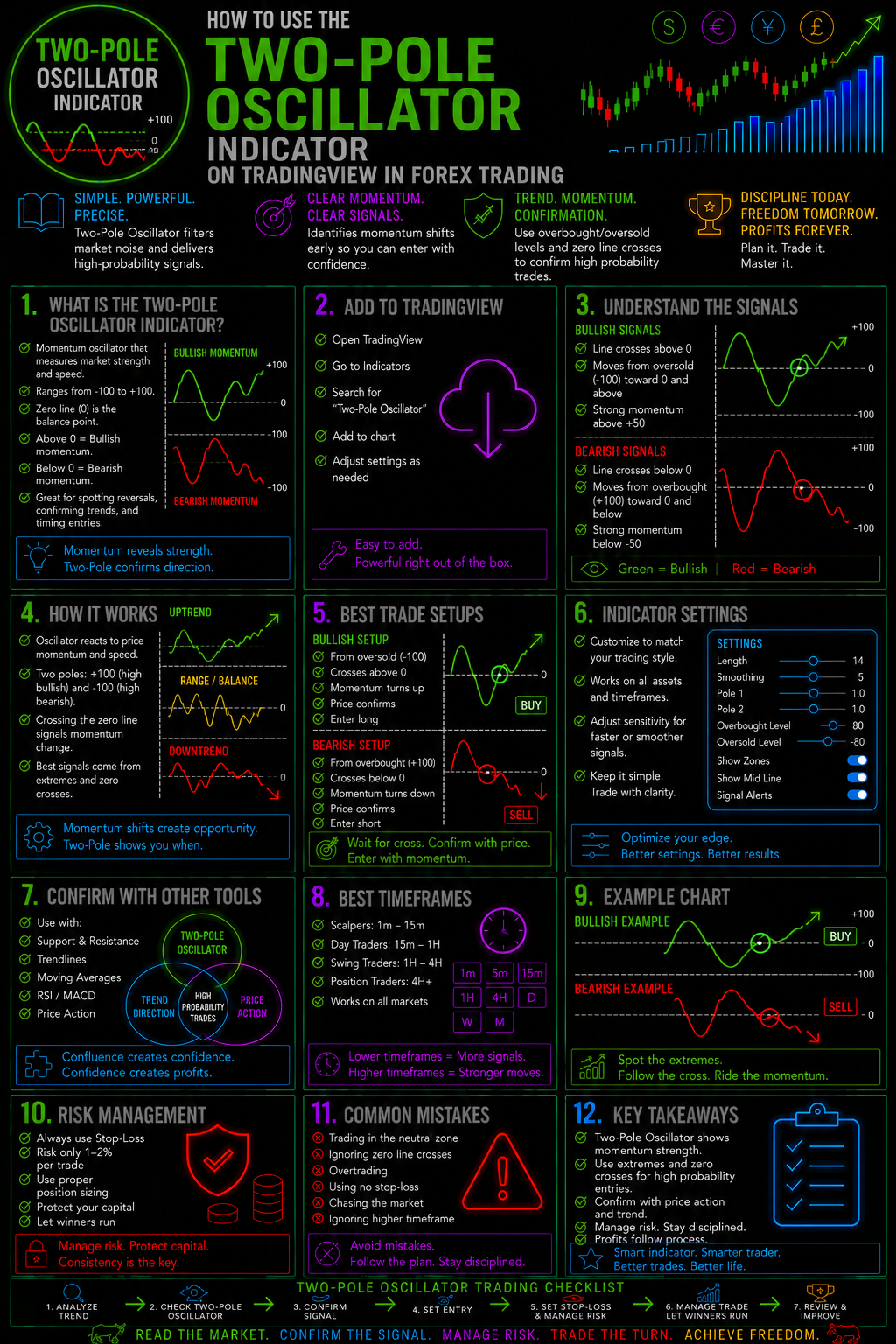
What Is The Two-Pole Oscillator Indicator?
The Two-Pole Oscillator Indicator is a technical analysis tool designed to help traders evaluate market momentum and identify potential changes in directional movement.
Rather than simply looking at whether price is moving higher or lower, an oscillator can help traders examine the strength and behavior of that movement.
This can be particularly useful in forex trading because currency pairs frequently transition between:
- Strong trends
- Weakening trends
- Momentum reversals
- Consolidation
- Breakouts
- Pullbacks
- New directional moves
The key is understanding that the indicator should not be treated as a standalone buy or sell machine.
Instead, it can become another layer of confirmation within a broader trading process.
WHY TRADERS SHOULD CARE
Price Tells You What Happened. Momentum Can Help Tell You What May Be Changing.
One of the biggest mistakes traders make is waiting until a trend is completely obvious.
By the time a move looks obvious, much of the initial opportunity may already have passed.
Momentum analysis can provide another perspective.
The Two-Pole Oscillator can be used to help traders watch for changes in momentum that may occur before or during significant changes in price behavior.
That makes it particularly interesting for traders who already use:
- Support and resistance
- Trendlines
- Japanese candlestick patterns
- Moving averages
- MACD
- RSI
- Market structure
- Breakout strategies
- Multi-timeframe analysis
The objective isn't to add more indicators simply for the sake of having more indicators.
The objective is to build better confluence.
HOW THE TWO-POLE OSCILLATOR WORKS
Understanding The Indicator Before Trading It
Before using any TradingView indicator in a live trading environment, you need to understand what the indicator is actually showing.
The Two-Pole Oscillator processes price information through smoothing techniques designed to produce an oscillator that can help traders evaluate directional momentum.
The resulting movement can provide traders with information about whether momentum is:
Increasing → Continuing → Weakening → Potentially Changing
This creates an important distinction.
A momentum shift does not automatically mean price will reverse.
Momentum can weaken while price continues moving in the same direction.
That is why the Two-Pole Oscillator should be interpreted alongside actual price action.
ADDING THE INDICATOR TO TRADINGVIEW
How To Add The Two-Pole Oscillator Indicator On TradingView
Adding an indicator to a TradingView chart is straightforward.
Open your TradingView chart and select the forex currency pair you want to analyze.
Popular examples include:
Step 2: Open The Indicators Menu
Select Indicators from the TradingView chart interface.
Search for:
Two-Pole Oscillator
Select the appropriate indicator from the available results.
Step 3: Add It To Your Chart
Once added, the oscillator will appear within the chart interface.
You can then adjust its settings according to the indicator's available parameters and your trading approach.
Step 4: Study It Before Trading It
Don't immediately start taking trades because the oscillator moves in a particular direction.
Spend time comparing the indicator with historical price action.
Look at:
- Strong trends
- Weak trends
- Reversals
- Pullbacks
- Consolidation
- Breakouts
- False signals
This is where the real learning begins.
READING THE SIGNAL
How To Read The Two-Pole Oscillator
The most important skill isn't adding the indicator.
It's interpreting what it is telling you in context.
When the oscillator moves in alignment with price direction, it can provide momentum confirmation.
When the oscillator begins moving differently from price, traders should become more alert.
For example:Bullish Momentum
A strengthening oscillator accompanied by bullish price action may indicate that upside momentum is increasing.
This can become more interesting when price is also:Bearish Momentum
- Breaking resistance
- Creating higher highs
- Holding a bullish trendline
- Forming a bullish candlestick pattern
A weakening or bearish oscillator reading accompanied by declining price action may indicate increasing downside momentum.
Confirmation becomes stronger when price is also:
- Breaking support
- Creating lower lows
- Rejecting resistance
- Forming bearish candlestick patterns
THE MOST IMPORTANT CONCEPT
Don't Trade The Oscillator. Trade The Confluence.
This is where many traders go wrong.
They see an oscillator turn bullish and immediately buy.
Or they see it turn bearish and immediately sell.
That approach can create a serious problem.
An oscillator is information—not a complete trading strategy.
Instead, consider combining momentum information with market structure.
For example:
Price Structure + Support/Resistance + Candlestick Confirmation + Momentum
Now you aren't making a trading decision based on one signal.
You're looking for multiple pieces of evidence pointing in the same direction.
TWO-POLE OSCILLATOR FOREX STRATEGY
A Simple Confluence-Based Trading Approach
Here's a framework you can use when studying the Two-Pole Oscillator in forex.
STEP 1 — Identify The Market Trend
Determine whether the currency pair is:
- Bullish
- Bearish
- Range-bound
- Transitioning
Don't start with the oscillator.
Start with the market.
STEP 2 — Identify A Key Price Level
Look for important:
- Support
- Resistance
- Previous highs
- Previous lows
- Breakout levels
- Retest zones
STEP 3 — Wait For Price To Reach The Area
Don't chase the market.
Allow price to come to your predetermined area of interest.
STEP 4 — Watch Momentum
Now bring the Two-Pole Oscillator into the decision-making process.
Is momentum supporting the potential trade?
Or is momentum contradicting it?
STEP 5 — Look For Price Confirmation
Look for a meaningful price-action signal.
This could include:
- Rejection candles
- Engulfing patterns
- Breakouts
- Break-and-retest structures
- Higher lows
- Lower highs
STEP 6 — Define Risk Before Entry
Before entering a trade, determine:
Entry → Stop Loss → Position Size → Profit Target
Never allow the indicator to determine your risk for you.
STEP 7 — Execute Only When The Setup Aligns
When multiple factors agree, you have a stronger technical argument.
When they don't agree, patience may be the better trade.
MULTI-TIMEFRAME ANALYSIS
Use The Two-Pole Oscillator Across Multiple Timeframes
One of the most powerful ways to improve technical analysis is to stop looking at a single timeframe in isolation.
For example:Higher Timeframe
Use the higher timeframe to establish the broader market direction.Middle Timeframe
Look for the developing setup.Lower Timeframe
Use the lower timeframe for more precise trade execution.
This creates a simple hierarchy:
Direction → Setup → Entry
The Two-Pole Oscillator can be incorporated into each stage, but its interpretation should always remain connected to the timeframe you're analyzing.
COMMON MISTAKES
5 Mistakes Traders Make With Oscillator Indicators
1. Treating Every Signal As A Trade
Not every oscillator movement creates a tradable opportunity.
2. Ignoring Price Structure
Momentum without market context can produce misleading signals.
3. Entering Too Early
A developing momentum shift isn't necessarily a confirmed reversal.
4. Using Too Many Indicators
Adding indicator after indicator can create confusion rather than clarity.
5. Ignoring Risk Management
Even an excellent-looking setup can fail.
Your risk management must assume that it can happen.
TWO-POLE OSCILLATOR + JAPANESE CANDLESTICKS
Combine Momentum With Price Action
This is where the strategy becomes particularly powerful.
The oscillator provides momentum information.
Japanese candlesticks provide visual information about the battle between buyers and sellers.
Together, they can create a more complete analytical picture.
For example:
Support + Bullish Reversal Candle + Improving Momentum
is considerably more informative than simply:
Oscillator = Bullish
The same principle applies to bearish setups.
Resistance + Bearish Reversal Candle + Weakening Momentum
can create a compelling area for further analysis.
TWO-POLE OSCILLATOR VS. OTHER INDICATORS
Should You Replace Your Existing Indicators?
Not necessarily.
The Two-Pole Oscillator doesn't need to replace every tool you're currently using.
Instead, consider asking:
Does this indicator provide information I don't already have?
If you're already using several momentum indicators that essentially tell you the same thing, adding another may provide little additional value.
But if the Two-Pole Oscillator gives you a different way to evaluate momentum transitions, it may become useful as part of your trading framework.
The goal isn't more indicators.
The goal is better information.
BUILD YOUR OWN TRADING SYSTEM
Stop Collecting Indicators. Start Building A Trading Process.
A professional approach to technical analysis isn't about finding the magical indicator that predicts every market move.
That indicator doesn't exist.
Instead, build a repeatable process.Your Trading Process Could Look Like:
1. Market Direction
↓
2. Key Price Level
↓
3. Price Action Setup
↓
4. Momentum Confirmation
↓
5. Entry Trigger
↓
6. Stop Loss
↓
7. Profit Target
↓
8. Trade Management
This is where individual indicators become useful.
They become components of a system, rather than random signals on a chart.
Take Your Forex Analysis Further
If you want to get more from the Two-Pole Oscillator, don't stop here.
Continue building your technical-analysis knowledge with Forex Trading Unlocked.Explore More Forex Trading Strategies
→ Japanese Candlestick Patterns
Learn how candlestick formations can reveal potential changes in buying and selling pressure.
→ MACD Forex Trading
Explore momentum, trend confirmation, and divergence using one of the most widely recognized technical indicators.
→ RSI Forex Trading
Learn how traders use RSI to evaluate momentum and potential overbought or oversold conditions.
→ Support & Resistance
Discover how major price levels can help define potential trading opportunities.
→ Forex Risk Management
Because identifying a trade is only half the equation. Managing risk determines how you survive long enough to exploit your edge.
→ Multi-Timeframe Forex Trading
Learn how to combine multiple chart timeframes into one structured trading process.
The biggest advantage isn't having another indicator.
It's knowing how to put the pieces together.
Get the Forex Trading Starter Kit and start building a more structured approach to analyzing the currency markets.GET THE FREE FOREX TRADING STARTER KIT
Learn. Analyze. Execute. Improve.
[GET THE FREE STARTER KIT →]
Learn From Experience—Not Hype
Forex Trading Unlocked is built around practical market education designed to help traders understand why a setup exists—not simply what button to press.
The objective is simple:
Give traders the knowledge, tools, and frameworks they need to make more informed trading decisions.
Technical indicators are tools.
Trading skill comes from knowing when, why, and how to use them.
Ready To Go Beyond Individual Indicators?
If you're tired of jumping from one indicator to another searching for the "perfect" trading system, it's time to build a process.
Learn how individual tools can work together through structured market analysis, risk management, price action, and trade execution.BUILD YOUR FOREX TRADING EDGE
Stop searching for the perfect indicator. Start building a better trading process.
[DISCOVER FOREX TRADING UNLOCKED →]
FAQ SECTION
Frequently Asked Questions
What Is The Two-Pole Oscillator Indicator?
The Two-Pole Oscillator is a technical analysis indicator that can be used to evaluate market momentum and identify potential changes in directional movement.
Can The Two-Pole Oscillator Be Used For Forex Trading?
Yes. Traders can use the indicator on forex charts to study momentum and potential changes in market direction.
Is The Two-Pole Oscillator A Buy And Sell Signal Indicator?
It should not be treated as an automatic buy or sell system. It is better used as one component of a broader technical-analysis process.
What Timeframe Should I Use With The Two-Pole Oscillator?
There is no single timeframe that works for every trader. The appropriate timeframe depends on your trading style, strategy, risk tolerance, and market conditions.
Can I Use The Two-Pole Oscillator With Other Indicators?
Yes. It can be combined with tools such as support and resistance, moving averages, MACD, RSI, candlestick patterns, and market structure to create additional confluence.
Does The Two-Pole Oscillator Predict Forex Reversals?
No indicator can reliably predict every reversal. The Two-Pole Oscillator can help identify changes in momentum, but traders should seek confirmation from price action and market structure.
Is The Two-Pole Oscillator Suitable For Beginners?
Beginners can study and use it, but they should first understand basic concepts such as market structure, support and resistance, risk management, and technical analysis.
Your Indicator Isn't Your Edge.
Your understanding of the market is.
The Two-Pole Oscillator can give you another perspective on momentum.
But the real opportunity comes from knowing how to combine that information with price, structure, confirmation, and risk management.
Don't just add another indicator to your TradingView chart.
Learn how to use it as part of a complete trading process.START BUILDING YOUR FOREX TRADING EDGE TODAY →
Forex Trading Unlocked
Learn Forex. Read The Market. Trade With A Plan.
👉 “Get Instant Access (Check Your Email)”
💥 IMPORTANT: One Last Step Required
After you enter your email, check your inbox (or spam folder) for a confirmation email.
👉 Click the confirmation link so I can send you your free Forex training.
⚠️ If you don’t confirm, I can’t send you anything.
👉 “⚠️ Access expires if not confirmed within 24 hours minutes.”
👉 “Takes 10 seconds. Instant access after email confirmation.”