How Market Sentiment Influences The Forex Markets
Learn How Trader Psychology, Fear, Greed, And Crowd Behavior Create Forex Opportunities
The forex market is driven by more than charts, indicators, and economic reports.
Behind every currency move are millions of traders, investors, institutions, hedge funds, and central banks making decisions based on expectations, emotions, and beliefs about the future.
This collective mindset is known as market sentiment.
Understanding market sentiment gives traders a powerful advantage because price does not move only because of what is happening today — it moves because of what traders believe will happen tomorrow.
At Forex Trading Unlocked, we believe mastering market psychology is one of the biggest differences between struggling traders and consistently improving traders.
Inside this guide, you will learn:
✅ What forex market sentiment really means
✅ How fear and greed influence currency prices
✅ How institutional traders use sentiment
✅ The best sentiment indicators for forex trading
✅ How to combine sentiment with technical analysis
✅ How to identify crowded trades before reversals
✅ How to use sentiment to improve trade timing
What Is Market Sentiment In Forex Trading?
Market sentiment represents the overall attitude and emotional positioning of traders toward a currency pair.
Simply put:
Market sentiment shows whether traders are generally optimistic or pessimistic about a currency’s future direction.
When traders believe a currency will rise:
➡️ Sentiment becomes bullish
When traders believe a currency will fall:
➡️ Sentiment becomes bearish
For example:
If investors expect the United States economy to strengthen, they may buy the US Dollar, creating bullish USD sentiment.
If traders fear recession, inflation, or political uncertainty, they may sell the Dollar, creating bearish USD sentiment.
The forex market constantly reflects these changing expectations.
Why Market Sentiment Matters In Forex
Many traders focus exclusively on technical indicators:
These tools are valuable, but they only show what price has done.
Market sentiment helps traders understand:
Why is price moving?
A currency pair can be technically overbought but continue rising because traders remain extremely bullish.
A currency pair can look oversold but continue falling because fear dominates the market.
Successful traders learn to combine:
Price Action + Technical Analysis + Market Sentiment
This creates a more complete view of the market.
The Psychology Behind Forex Market Movements
The forex market is ultimately controlled by human decisions.
Two major emotions influence nearly every market cycle:
Fear: The Force Behind Market Selloffs
Fear creates:
- Panic selling
- Risk reduction
- Safe-haven buying
- Increased volatility
During periods of uncertainty, traders often move money into perceived safe-haven currencies such as:
- US Dollar
- Japanese Yen
- Swiss Franc
Examples of fear-driven events:
- Financial crises
- Geopolitical conflicts
- Banking instability
- Unexpected economic data
Fear can create rapid currency movements because traders often react emotionally rather than logically.
Greed: The Fuel Behind Market Rallies
Greed drives:
- Momentum trading
- FOMO (fear of missing out)
- Excessive speculation
- Overextended trends
When traders see a currency rising, more participants jump into the move.
This creates a feedback loop:
Price rises → More traders buy → Demand increases → Price rises further
Eventually, the market becomes overcrowded.
This is often where experienced traders begin looking for reversal opportunities.
How Institutional Traders Use Market Sentiment
Large institutions do not only analyze charts.
They monitor:
- Investor positioning
- Hedge fund exposure
- Options markets
- Economic expectations
- Risk appetite
- Liquidity conditions
Professional traders understand an important concept:
When everyone is positioned the same way, the market becomes vulnerable.
For example:
If 90% of traders are long EUR/USD, there may be limited buyers left to push the market higher.
A small negative catalyst can trigger:
- Stop-loss activation
- Forced selling
- Sharp reversals
This is why sentiment analysis can help identify potential turning points.
The Relationship Between Risk Appetite And Forex
Global sentiment often moves between two conditions:Risk-On Environment
Traders feel confident.
Money flows toward:
- Higher-yielding currencies
- Emerging markets
- Risk assets
Common effects:
- AUD strengthens
- NZD strengthens
- JPY weakens
Risk-Off Environment
Traders become defensive.
Money moves toward safety.
Common effects:
- USD strengthens
- JPY strengthens
- CHF strengthens
Understanding risk sentiment helps traders anticipate broader currency movements.
The Best Forex Sentiment Indicators
1. Commitment of Traders (COT) Report
The COT report shows how large market participants are positioned.
Traders use it to identify:
- Extreme bullish positioning
- Extreme bearish positioning
- Potential reversal zones
The COT report is especially useful for longer-term currency analysis.
2. Retail Trader Positioning
Many brokers provide data showing whether retail traders are:
- Buying
- Selling
- Overexposed
A popular concept:
When retail traders are heavily positioned one direction, markets often move against the crowd.
This is known as the contrarian sentiment approach.
3. Volatility Indexes
Volatility reflects market fear.
When volatility rises:
- Traders become defensive
- Risk appetite decreases
- Safe-haven currencies often strengthen
4. News And Economic Expectations
Markets react not only to economic data but to whether results are:
Better or worse than expected.
Examples:
Strong employment report:
Expected → Limited reaction
Unexpectedly strong → Major currency movement
The difference between expectation and reality drives sentiment.
How To Combine Market Sentiment With Technical Analysis
The most powerful approach is combining sentiment with price action.
Example:Scenario:
EUR/USD is approaching major resistance.
Technical analysis shows:
✔ Resistance zone
✔ Bearish candlestick pattern
✔ Momentum weakening
Sentiment shows:
✔ Traders heavily long EUR/USD
✔ Market optimism is extreme
Together:
This creates a potential reversal setup.
The strongest opportunities often occur when:
Technical signals + Sentiment extremes + Market structure align.
Market Sentiment Trading Strategy Example
The Sentiment Reversal SetupStep 1: Identify Extreme Sentiment
Look for:
- Excessive bullish positioning
- Excessive bearish positioning
- One-sided market expectations
Step 2: Find A Technical Trigger
Wait for confirmation:
- Support/resistance rejection
- Candlestick reversal
- Trendline break
- Momentum divergence
Step 3: Manage Risk
Never trade sentiment alone.
Use:
- Proper position sizing
- Stop losses
- Risk-to-reward planning
Professional traders survive because they manage risk first.
Common Mistakes Traders Make With Market Sentiment
Mistake #1: Following The Crowd
The crowd is often late.
By the time everyone agrees on a direction, the move may already be exhausted.
Mistake #2: Ignoring Market Structure
Sentiment cannot replace technical analysis.
A bullish market can stay bullish longer than expected.
Mistake #3: Trading Emotions Instead Of Data
Successful traders analyze sentiment objectively.
They do not become:
- Too confident after wins
- Too fearful after losses
- Emotionally attached to positions
How Market Sentiment Creates Trading Opportunities
Every market cycle creates emotional extremes:Accumulation Phase
Smart money begins building positions.Expansion Phase
The trend becomes obvious.Euphoria Phase
Everyone joins the move.Distribution Phase
Institutions begin exiting.Panic Phase
Late traders sell at the worst time.
Understanding these cycles helps traders avoid entering when risk is highest.
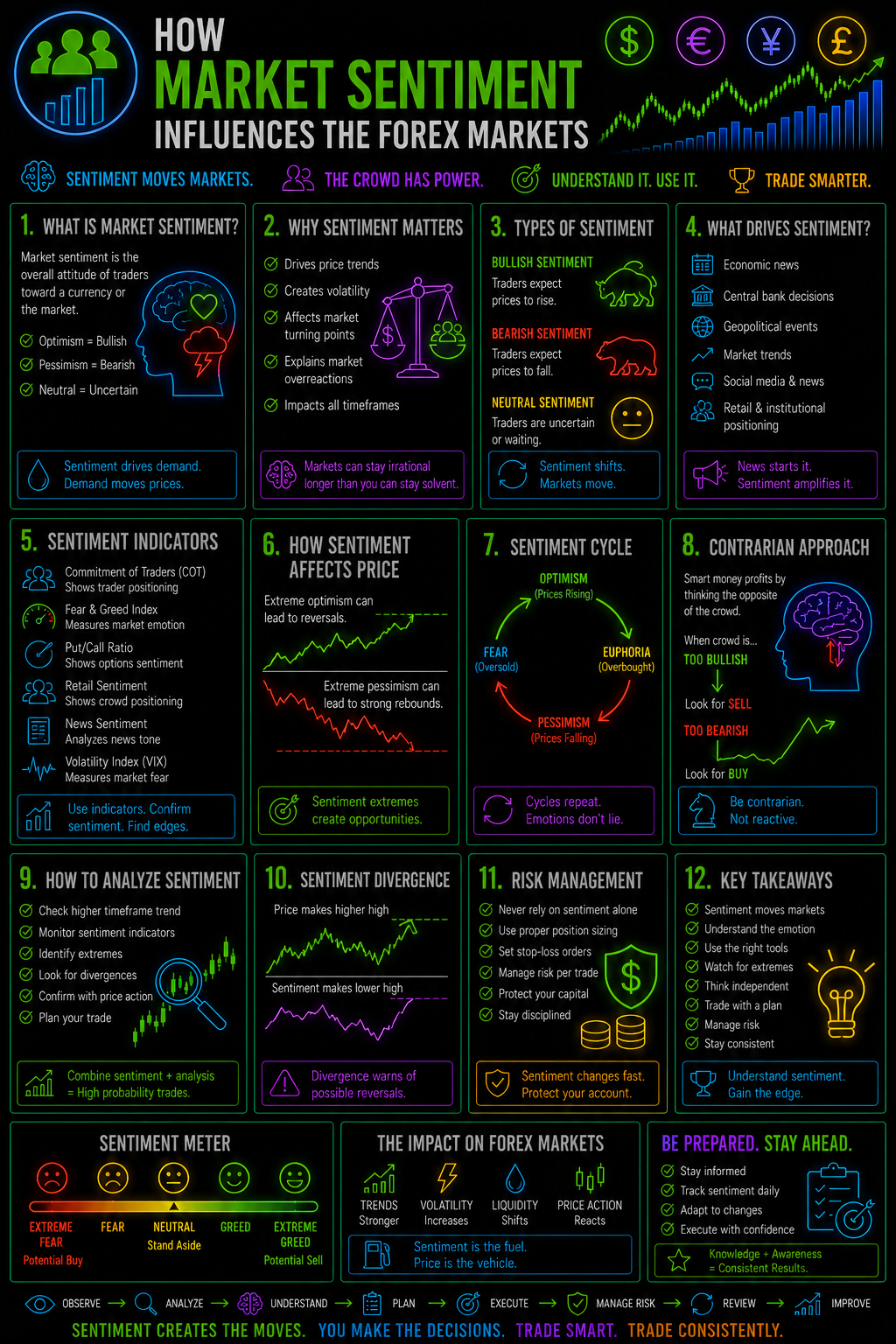
Master Forex Market Psychology With Forex Trading Unlocked
Market sentiment is one of the hidden forces controlling currency markets.
The traders who understand sentiment can better recognize:
✔ Trend continuation opportunities
✔ Potential reversals
✔ Market extremes
✔ Institutional positioning
✔ Emotional market cycles
At Forex Trading Unlocked, we combine decades of trading experience with proven strategies, technical analysis, and professional market insights to help traders develop a complete approach to the forex markets.
Continue Your Forex Trading Education
Recommended Next Lessons:
➡️ How Forex Trading Psychology Impacts Your Results
➡️ How To Trade Market Cycles In The Forex Markets
➡️ How Interest Rates Influence Forex Markets
➡️ How Central Banks Impact Forex Markets
➡️ Forex Liquidity Zones Explained
➡️ Forex Trading Risk Management Guide
Download Your Free Forex Trading Starter Kit
Stop guessing. Start understanding the forces that move the forex markets.
Get instant access to:
✅ Forex Trading Beginner Guide
✅ High Probability Forex Setups
✅ Japanese Candlestick Cheat Sheet
✅ Risk Management Blueprint
[GET YOUR FREE FOREX TRADING STARTER KIT NOW]
Ready To Take Your Trading To The Next Level?
Market sentiment separates average traders from informed traders.
Learn how professional traders combine:
Market Psychology + Price Action + Technical Analysis + Risk Management
to identify higher-probability forex opportunities.
Join Forex Trading Unlocked and start building your trading edge today.
[START YOUR FOREX JOURNEY NOW]
Suggested Internal Links
"Learn The Same Market Psychology Concepts Used By Professional Traders"
Forex-Psychology-Guide
How-The-Forex-Market-Works
Best-Japanese-Candlestick-Patterns
Forex-Trading-Risk-Management-Guide
How-To-Trade-Market-Cycles-In-The-Forex-Markets
How-To-Trade-Volatility-In-The-Forex-Markets
How-Interest-Rates-Influence-Forex-Markets
👉 “Get Instant Access (Check Your Email)”
💥 IMPORTANT: One Last Step Required
After you enter your email, check your inbox (or spam folder) for a confirmation email.
👉 Click the confirmation link so I can send you your free Forex training.
⚠️ If you don’t confirm, I can’t send you anything.
👉 “⚠️ Access expires if not confirmed within 24 hours minutes.”
👉 “Takes 10 seconds. Instant access after email confirmation.”