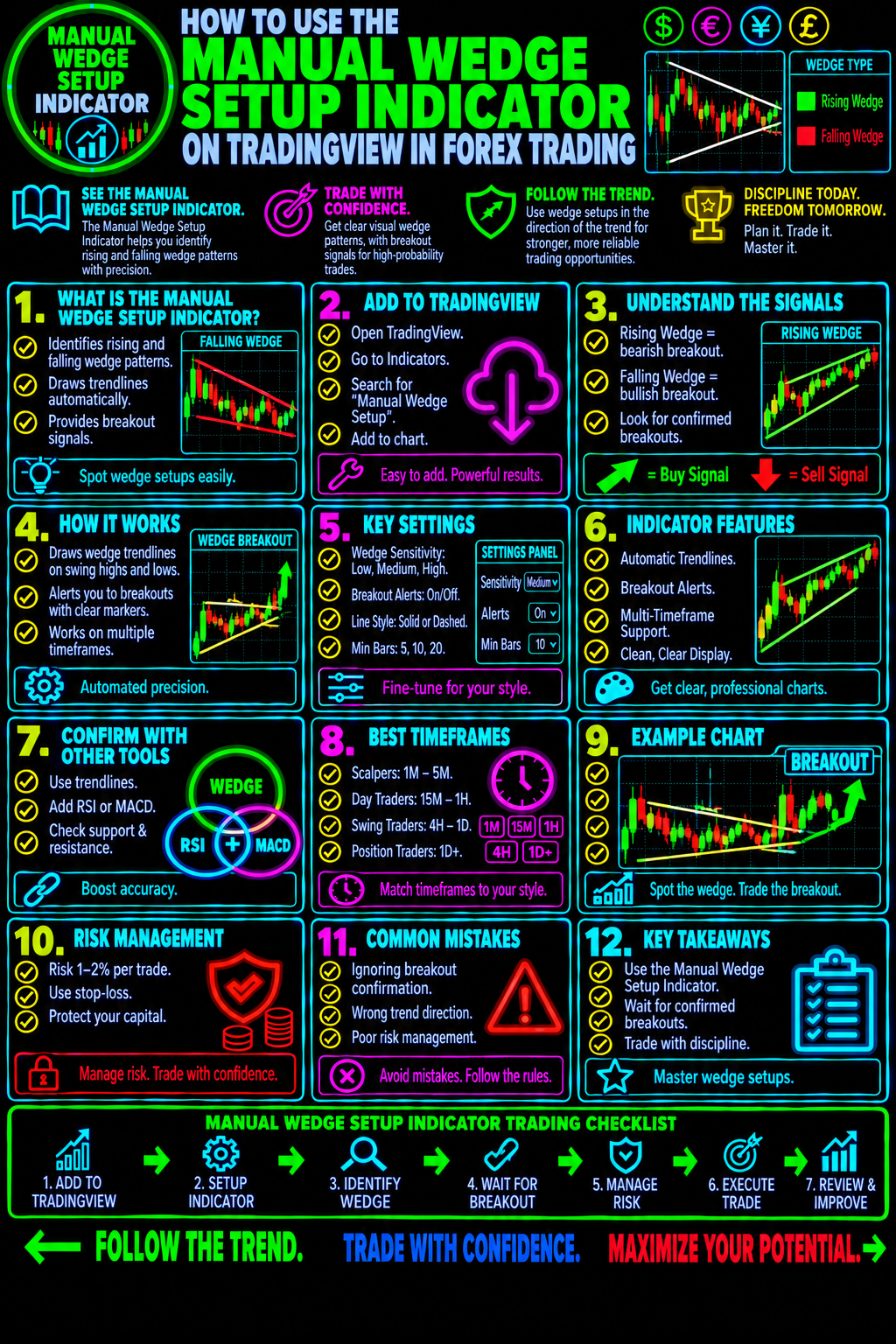
How To Use The Manual Wedge Setup Indicator On TradingView In Forex Trading
Identify Forex Wedge Patterns. Prepare For Breakouts. Improve Your Trading Entries.
Forex markets constantly move through periods of consolidation, compression, and expansion. Some of the most powerful trading opportunities develop when price action begins forming recognizable wedge patterns.
The challenge? Identifying these formations early, understanding their structure, and determining when a potential breakout is worth trading.
The Manual Wedge Setup Indicator on TradingView gives forex traders a practical way to identify and work with wedge formations directly on their charts. Instead of relying entirely on visual guesswork, traders can use manually defined wedge structures to organize their technical analysis and prepare for potential trading opportunities.
Whether you trade EURUSD, GBPUSD, USDJPY, or other currency pairs, understanding how to use wedge formations can add another valuable dimension to your trading strategy.
Welcome to Forex Trading Unlocked, where we help traders turn technical analysis into a structured trading approach.
What Is The Manual Wedge Setup Indicator?
The Manual Wedge Setup Indicator is a TradingView charting tool designed around manually identifying and defining wedge formations.
A wedge develops when price moves between two converging trendlines. These boundaries gradually narrow as price action becomes compressed.
Wedges can provide clues about potential changes in market direction, continuation opportunities, and upcoming volatility.
There are two primary wedge formations every forex trader should understand:
1. Rising Wedge Pattern
A rising wedge forms when price creates higher highs and higher lows, but the distance between the two boundaries gradually contracts.
Although price is moving upward, the narrowing structure can indicate weakening bullish momentum.
What traders look for:
- Price approaching the upper wedge boundary.
- Weakening upward momentum.
- A potential bearish breakdown below wedge support.
- Confirmation through a candle close below the lower trendline.
A rising wedge can develop during an existing uptrend or during a corrective upward move within a larger downtrend.
2. Falling Wedge Pattern
A falling wedge develops when price creates lower highs and lower lows while the distance between the two trendlines contracts.
This formation can indicate that selling pressure is weakening and a bullish reversal or continuation may be developing.
What traders look for:
- Price approaching the lower wedge boundary.
- Declining bearish momentum.
- A potential bullish breakout above wedge resistance.
- Confirmation through a candle close above the upper trendline.
Neither formation guarantees a reversal. Market context and confirmation remain essential.
How Does The Manual Wedge Setup Indicator Work?
The Manual Wedge Setup Indicator provides a framework for working with wedge formations on TradingView.
The manual component is important.
Rather than assuming every narrowing price movement represents a valid wedge, the trader uses market structure and technical analysis to determine where the formation begins and ends.
Depending on the indicator's available settings and drawing controls, traders can use it to:
- Define the upper and lower wedge boundaries.
- Evaluate converging price structures.
- Monitor price as it approaches either trendline.
- Identify potential breakout areas.
- Prepare entry, stop-loss, and profit-target scenarios.
The objective is to make wedge analysis more organized and repeatable.
Important: Specific controls and features depend on the indicator version. Always verify the available settings in your TradingView installation.
How To Set Up The Manual Wedge Setup Indicator On TradingView
Getting started is straightforward.
Step 1: Open TradingView
Visit TradingView and open your preferred forex trading chart.
Select the currency pair you want to analyze.
Popular choices include:
Step 2: Locate The Indicator
Open the TradingView Indicators menu.
Search for:
Manual Wedge Setup Indicator
Select the appropriate indicator if it is available in your TradingView indicator library.
If you are using a private or invite-only script, follow the access instructions supplied by its publisher.
Step 3: Apply The Indicator To Your Chart
Add the indicator to your chart and examine its available settings and controls.
Familiarize yourself with how the indicator handles wedge boundaries and any associated visual elements.
Step 4: Select Your Trading Timeframe
Wedge formations can develop across multiple timeframes.
Consider these common choices:
Timeframe Trading application
5-Minute Short-term scalping
15-Minute Intraday setups
1-Hour Intraday and swing setups
4-Hour Swing trading
Daily Longer-term market structure
For many forex traders, the 1-hour and 4-hour charts provide a useful balance between identifying formations and filtering out some lower-timeframe market noise.
How To Identify High-Probability Wedge Trading Setups
Not every wedge formation deserves your trading capital.
One of the biggest mistakes forex traders make is assuming that every converging price structure will produce a profitable breakout.
Professional technical analysis requires more than recognizing a shape.
Here are five factors to evaluate.
1. Identify Clear Swing Highs And Swing Lows
A reliable wedge formation should have recognizable price boundaries.
Look for multiple meaningful reactions along both sides of the formation.
Avoid forcing trendlines through random price movements simply to create a wedge.
2. Look For Converging Trendlines
The upper and lower boundaries should move toward one another.
If the trendlines remain parallel, you may be looking at a channel rather than a wedge.
3. Evaluate Momentum
Price compression can provide valuable information about changing market conditions.
Consider combining wedge analysis with momentum indicators such as:
Momentum confirmation can help determine whether the developing breakout has supporting market conditions.
4. Wait For Breakout Confirmation
This is where patience becomes important.
A temporary move outside a wedge boundary does not necessarily represent a genuine breakout.
Look for:
- A decisive candle close outside the formation.
- Increased directional momentum.
- Follow-through price action.
- A successful retest of the broken boundary, when one develops.
Avoid entering simply because price touches a trendline.5. Evaluate The Larger Market Trend
A wedge formation should never be evaluated in isolation.
Check the higher timeframe to determine whether the setup aligns with the broader market structure.
A bullish wedge breakout into significant higher-timeframe resistance may have less room to develop than one breaking into an open price area.
The Manual Wedge Breakout Trading Strategy
Let's put the analysis together into a practical trading framework.Bullish Falling Wedge Trade Setup
Bullish setup
A potential bullish trade develops when price breaks above the upper boundary of a falling wedge.
Trading process:
- Identify a clearly defined falling wedge.
- Establish the upper resistance and lower support boundaries.
- Monitor price as the formation contracts.
- Wait for a confirmed bullish breakout.
- Look for a possible retest of the former resistance boundary.
- Evaluate bullish candlestick confirmation.
- Calculate your entry, stop-loss, and profit target.
- Execute only when the potential reward justifies the risk.
Stop-loss consideration: A protective stop may be placed below a relevant swing low or the retest structure, depending on market volatility and the setup.
Profit-target consideration: Potential targets can include previous swing highs, nearby resistance, or a measured-move projection based on the wedge's widest section.
Bearish Rising Wedge Trade Setup
Bearish setup
A potential bearish opportunity develops when price breaks below the lower boundary of a rising wedge.
Trading process:
- Identify a clearly defined rising wedge.
- Establish the upper resistance and lower support boundaries.
- Monitor the narrowing price structure.
- Wait for a confirmed bearish breakdown.
- Look for a possible retest of the former support boundary.
- Evaluate bearish candlestick confirmation.
- Calculate your entry, stop-loss, and profit target.
- Execute only when the trade meets your risk-management requirements.
Stop-loss consideration: Consider placing protection above a relevant swing high or the retest structure.
Profit-target consideration: Evaluate previous swing lows, nearby support, and measured-move projections.
Remember: A breakout is a trading opportunity to evaluate, not a guarantee of future price direction.
Combine The Manual Wedge Setup Indicator With Japanese Candlestick Patterns
One of the most effective ways to strengthen wedge analysis is to combine it with Japanese candlestick formations.
Why?
Because the wedge helps define the market structure, while candlesticks can provide additional information about buying and selling pressure.
Consider watching for these formations near wedge boundaries:
Candlestick pattern Potential trading significance
Bullish Engulfing Potential bullish reversal
Bearish Engulfing Potential bearish reversal
Hammer Potential bullish rejection
Shooting Star Potential bearish rejection
Morning Star Potential bullish reversal
Evening Star Potential bearish reversal
Doji Potential market indecision
A bullish engulfing candle following a falling wedge breakout may provide additional evidence of buying pressure.
Likewise, a bearish engulfing candle following a rising wedge breakdown may reinforce a bearish trading scenario.
Want to become better at recognizing profitable candlestick formations?
Explore our comprehensive guide:
High Probability Japanese Candlestick Patterns Every Trader Must Know
Learn how to recognize market reversals, identify potential continuation patterns, and understand what price action may be communicating.
Improve Your Wedge Trading With Multiple Timeframe Analysis
One of the most common mistakes traders make is analyzing a wedge on only one timeframe.
Multiple timeframe analysis can help put a potential setup into perspective.
Consider this approach:
Timeframe Purpose
Daily Identify the broader market trend
4-Hour Evaluate major market structure
1-Hour Identify the wedge formation
15-Minute Refine potential trade entries
For example, imagine EUR/USD is showing a bullish structure on the daily chart.
On the 4-hour chart, price begins consolidating into a falling wedge.
On the 1-hour chart, the wedge boundaries become increasingly clear.
Finally, the 15-minute chart provides an opportunity to examine breakout confirmation and potential entry conditions.
This approach helps prevent traders from taking isolated chart patterns without considering the bigger picture.
Explore more of our technical analysis resources:
- Forex Market Structure Trading
- Forex Support And Resistance Trading
- Forex Trendline Trading Strategies
Risk Management: Protect Your Trading Capital
Even the best-looking wedge formation can fail.
False breakouts, unexpected economic announcements, liquidity conditions, and sudden volatility can all change the direction of a trade.
Your trading strategy must account for those possibilities.
Here are five important risk-management principles.
1. Risk only a predetermined percentage of your account.
Many traders use 1% or less of their account balance as a starting risk guideline.
2. Always determine your stop-loss before entering.
Never enter a trade without knowing where your trading idea becomes invalid.
3. Evaluate the risk-to-reward ratio.
A potential 2:1 reward-to-risk setup means the projected reward is twice the amount being risked.
4. Avoid chasing breakouts.
If price has already moved significantly beyond the wedge, the original entry opportunity may have passed.
5. Account for economic news.
Major central bank announcements, inflation reports, employment data, and interest-rate decisions can produce sharp price movements.
Build a consistent risk-management process with our:
Your objective is not to win every trade. It is to protect your capital and maintain a trading process that can withstand losing trades.
Common Mistakes When Trading Wedge Patterns
Understanding what not to do can be just as important as understanding the actual setup.
Common mistake Better trading practice
Forcing wedge trendlines Use meaningful swing points
Trading every wedge Be selective
Entering before confirmation Wait for a decisive breakout
Ignoring higher timeframes Evaluate broader market structure
Using oversized positions Follow predetermined risk limits
Chasing extended breakouts Wait for another opportunity
Ignoring economic news Monitor the economic calendar
The Manual Wedge Setup Indicator should be treated as one component of a complete trading strategy, not a standalone trading system.
Is The Manual Wedge Setup Indicator Worth Using?
For traders who incorporate chart patterns into their technical analysis, a manual wedge setup tool can provide a useful framework for organizing potential opportunities.
Its value depends on how effectively you combine wedge identification with:
- Market structure analysis.
- Trend direction.
- Support and resistance.
- Momentum confirmation.
- Japanese candlestick patterns.
- Multiple timeframe analysis.
- Proper risk management.
The real advantage comes from developing a repeatable process rather than searching for a shortcut to profitable trades.
Take Your Forex Trading Skills To The Next Level With Forex Trading Unlocked
Free Forex Trading Resources
Identifying wedge formations is just one part of becoming a more knowledgeable and disciplined forex trader.
At Forex Trading Unlocked, we provide educational resources designed to help traders understand technical analysis, trading strategies, market behavior, and risk management.
Whether you are just beginning your forex journey or looking to improve an established trading approach, we have resources to help you develop your skills.
Get Your FREE Forex Trading Starter Kit
Start building a stronger foundation with our FREE Forex Trading Starter Kit.
Inside, discover essential forex trading concepts, technical analysis fundamentals, trading strategies, and risk-management principles.
GET YOUR FREE FOREX TRADING STARTER KIT HERE
Master High Probability Forex Trading Setups
Want to move beyond recognizing chart patterns?
Learn how to combine candlesticks, trend shifts, market structure, and technical indicators to identify and evaluate potential forex trading opportunities.
Explore our educational trading resources and courses at Forex Trading Unlocked.
EXPLORE FOREX TRADING STRATEGIES AND EDUCATION Explore TradingView Charting Tools
TradingView provides powerful charting capabilities for analyzing currency markets and developing technical trading strategies.
DISCOVER TRADINGVIEW CHARTING AND TRADING TOOLS
Frequently Asked Questions About The Manual Wedge Setup Indicator
1. What is the Manual Wedge Setup Indicator?
It is a TradingView indicator designed to help traders manually define and evaluate wedge formations on price charts.
2. Can the Manual Wedge Setup Indicator identify bullish and bearish wedges?
The manual wedge analysis process can be used to evaluate both rising and falling wedge formations.
3. What is the best timeframe for trading wedge patterns?
The 1-hour and 4-hour charts are useful starting points for many forex traders. However, the best timeframe depends on your trading style and strategy.
4. Does a falling wedge always produce a bullish breakout?
No. A falling wedge can fail or break lower. Traders should wait for confirmation and evaluate the broader market environment.
5. Does a rising wedge always produce a bearish reversal?
No. Rising wedges can produce failed breakdowns or continue developing. Confirmation is essential before considering a trade.
6. Can I combine wedge patterns with MACD and RSI?
Yes. MACD and RSI can provide additional momentum information that may help evaluate the quality of a developing wedge breakout.
7. Is the Manual Wedge Setup Indicator suitable for beginners?
Beginners can learn to use wedge formations, but they should first understand trendlines, swing highs and lows, support and resistance, and basic risk management.
Final Thoughts: Turn Forex Chart Patterns Into A Trading Advantage
The Manual Wedge Setup Indicator provides forex traders with another way to organize technical analysis and evaluate potential market opportunities.
Rising wedges, falling wedges, price compression, and breakout confirmation can all contribute to a structured approach to trading the forex market.
But remember one important principle:
Recognizing a chart pattern is only the beginning. Knowing when to trade it, when to avoid it, and how much capital to risk is what separates a disciplined trading approach from guesswork.
Continue developing your technical analysis skills with Forex Trading Unlocked.
Learn the patterns. Understand the market. Manage your risk. Trade with a plan.
Forex Trading Unlocked Inc. — Unlock Your Forex Trading Potential.
👉 “Get Instant Access (Check Your Email)”
💥 IMPORTANT: One Last Step Required
After you enter your email, check your inbox (or spam folder) for a confirmation email.
👉 Click the confirmation link so I can send you your free Forex training.
⚠️ If you don’t confirm, I can’t send you anything.
👉 “⚠️ Access expires if not confirmed within 24 hours minutes.”
👉 “Takes 10 seconds. Instant access after email confirmation.”