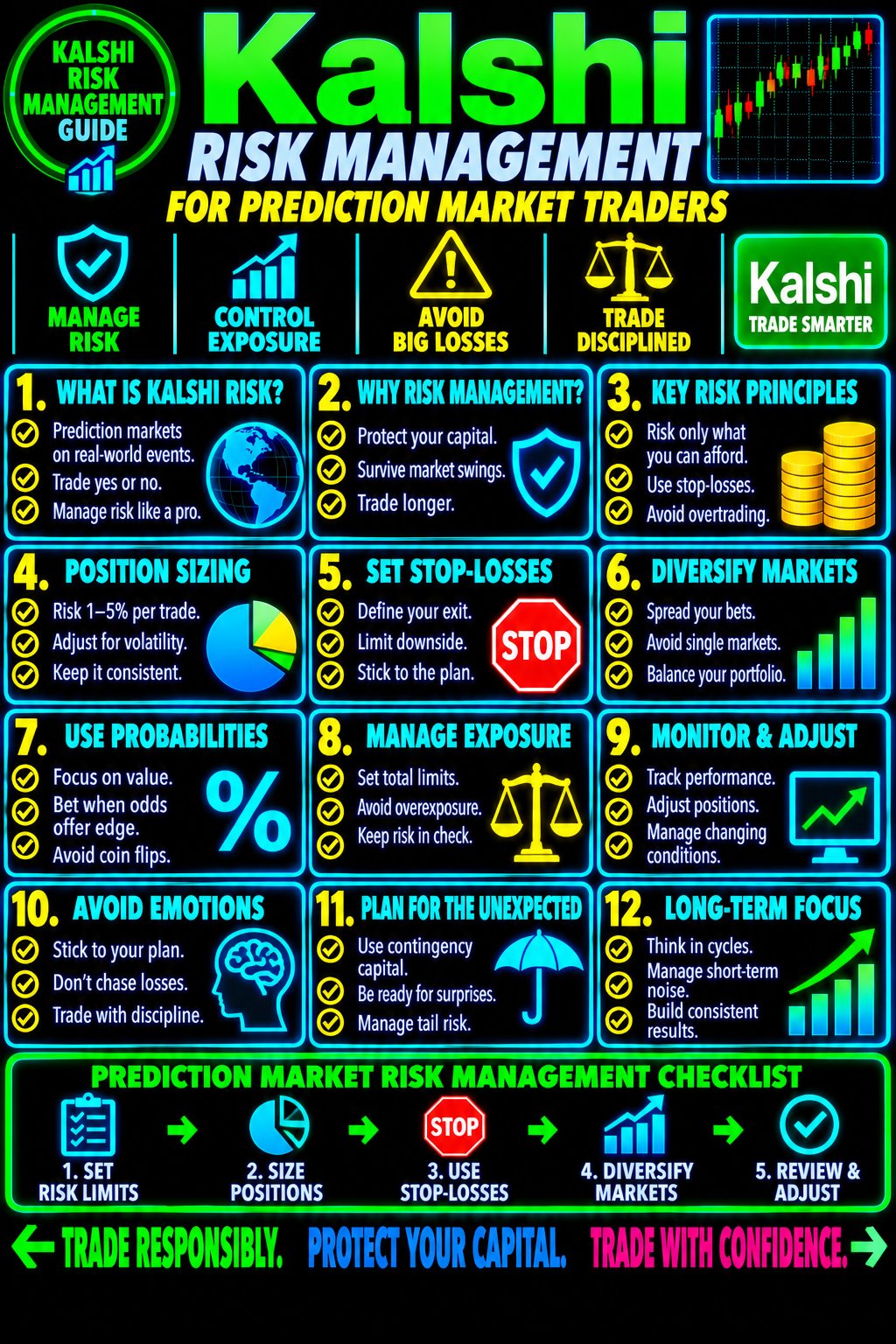
Kalshi Risk Management For Prediction Market Traders
Protecting Capital and Managing Exposure
1. Introduction: Why Risk Management Matters in Prediction Markets
Prediction markets create opportunities to trade expectations surrounding economic events, financial developments, political outcomes, and other measurable events.
But having an opinion about what will happen is not enough.
A trader can correctly identify an important economic development and still lose money by entering at an unfavorable price, committing too much capital, ignoring transaction costs, or failing to account for uncertainty.
This is why risk management is essential.
On Kalshi, every event contract has its own pricing, settlement conditions, expiration details, and potential financial consequences. Traders must understand these factors before deciding how much capital to commit.
At Forex Trading Unlocked (FTU), we believe disciplined risk management is one of the most important foundations of successful trading.
The same principles that help Forex traders manage exposure can also help prediction-market participants develop a more structured approach.
In this guide, we will examine how to:
- Protect your trading capital.
- Establish risk limits.
- Calculate appropriate contract positions.
- Manage exposure across related events.
- Understand probability and pricing risk.
- Account for fees and liquidity.
- Build a repeatable prediction-market trading plan.
The objective is simple: make risk management part of every trade instead of thinking about it only after something goes wrong.
2. Understand the Maximum Risk of a Kalshi Contract
Before entering any Kalshi position, understand exactly how much money is at risk.
For a standard purchased binary Yes or No contract, assume the following hypothetical example:
- Contract purchase price: $0.40
- Potential winning settlement: $1.00
- Losing settlement: $0.00
- Number of contracts: 100
The position would have the following characteristics:
Item Amount
Purchase price $0.40
Contracts purchased 100
Initial purchase cost $40
Potential settlement payout $100
Gross profit if correct $60
Maximum loss if incorrect $40
These figures exclude transaction fees and assume the contract follows the standard $1/$0 settlement structure.
The important distinction is that the $100 payout is not the profit. The original $40 purchase cost must be deducted.
If the event settles against the position, the trader loses the $40 purchase cost, plus applicable fees.
The first rule of prediction-market risk management is to know your maximum potential loss before entering the trade.
Always read the individual contract specifications. Not every product necessarily follows identical payout or settlement arrangements.
3. Establish a Prediction-Market Risk Budget
One of the biggest mistakes traders make is deciding how much to invest based on how confident they feel about an outcome.
Confidence is not a substitute for risk management.
A better approach is to establish a risk budget before analyzing individual opportunities.
For example, consider a hypothetical prediction-market account with $5,000 in available capital.
A trader might examine different possible risk allocations:
Illustrative Risk Percentage Maximum Planned Loss
0.25% $12.50
0.50% $25.00
1.00% $50.00
2.00% $100.00
These are examples for educational purposes, not universal recommendations.
The appropriate risk budget depends on the trader's financial circumstances, experience, account objectives, and total exposure.
The important principle is consistency.
A trader should not risk $25 on one event, $250 on another, and $500 on a third simply because one prediction feels more convincing.
A structured risk budget helps prevent emotional decisions from controlling position size.
4. Use Position Sizing to Control Risk
Position sizing determines how many contracts a trader can purchase without exceeding a predetermined risk limit.
For a standard purchased binary contract, a basic calculation is:
Contract Quantity - (Maximum Planned Loss / Contract Purchase Price)
Suppose:
- Account capital: $5,000
- Planned risk budget: $25
- Contract price: $0.50
The calculation is:
($25.00 / $0.50) - 50
The trader could purchase 50 contracts for a total cost of $25 before fees.
If the contracts settle at zero, the loss would be $25 plus applicable fees.
If they settle at $1 each, the gross payout would be $50, producing a $25 gross profit before costs.
This is a simple but useful method of controlling exposure.
For a deeper explanation and interactive calculation, see our related article:
Kalshi Contract Position Sizing: How to Manage Risk and Calculate Trade Size
Kalshi-Contract-Position-Sizing.html
5. Never Confuse Contract Price With Probability Certainty
Kalshi contract prices can provide information about market expectations, but they should not be treated as guaranteed forecasts.
For example, a Yes contract trading at $0.75 may suggest an implied probability of approximately 75% under a standard $1 settlement structure.
However, this does not establish that the event has an objectively measured 75% chance of occurring.
Contract prices are influenced by:
- Available buyers and sellers.
- Market liquidity.
- Bid-ask spreads.
- Participant positioning.
- Trading costs.
- New information.
- Differences in individual expectations.
A market price is an indication of current trading conditions, not a guarantee of the underlying event's probability.
This distinction matters because traders can become overconfident when a contract appears to have a high probability of winning.
A 75-cent contract can still lose its entire purchase value if the event settles against it.
Risk management requires recognizing that even high-confidence positions can produce losses.
6. Diversification: Avoid Concentrating Your Capital in One Event
Diversification is another important part of prediction-market risk management.
A trader may hold several contracts and believe the portfolio is diversified because each contract involves a different question.
But different questions can depend on the same underlying economic factors.
Consider a trader holding:
- A Federal Reserve rate-cut contract.
- A U.S. inflation contract.
- A U.S. employment contract.
- A U.S. economic growth contract.
These are separate events, but they may be closely connected.
For example, stronger-than-expected inflation could influence interest-rate expectations, affect Treasury yields, and change the market's assessment of future economic growth.
If all four positions depend on a similar economic scenario, the trader may have substantial concentrated exposure.
This is comparable to correlation risk in Forex trading.
A Forex trader holding multiple dollar-sensitive currency pairs may discover that several positions are effectively dependent on the same U.S. dollar outlook.
The same principle applies to prediction markets.
Think about diversification by economic exposure, not simply by the number of contracts held.
7. Manage Risk Across Multiple Prediction-Market Positions
A useful way to manage a portfolio is to examine total exposure before adding another position.
Consider this hypothetical portfolio:
Contract Maximum Planned Loss
Federal Reserve rate decision $25
U.S. inflation outcome $20
Employment report $15
GDP growth outcome $20
Total exposure $80
The individual positions may appear manageable, but the combined exposure is $80 before applicable fees.
If the underlying contracts are economically related, the potential portfolio loss may be concentrated in one broad scenario.
Before opening another position, ask:
- Does this contract depend on the same economic outlook as my existing positions?
- Could one unexpected announcement negatively affect several positions?
- How much total capital is already committed?
- Would a new position increase concentration risk?
- Can the portfolio withstand several incorrect outcomes?
This approach is particularly important when trading multiple economic contracts around major Federal Reserve announcements, inflation releases, or employment reports.
8. Understand Liquidity and Execution Risk
A position may look attractive on the screen but become difficult to enter or exit at the desired price.
Kalshi uses an order book where available buyers and sellers determine the prices at which contracts can be traded.
This creates several important considerations.
Bid-ask spreads
A wide spread can increase the cost of entering and exiting a position.
Market depth
There may not be enough available contracts at the displayed price to execute a larger order.
Slippage
A large market order may execute at several different prices, increasing the average purchase cost.
Early exits
A trader may want to close a position before settlement but discover that available buyers are offering less than the expected value.
For example, a trader who purchases a contract at $0.50 may later find that the best available bid is only $0.43.
Selling at that price would realize a loss, even though the event has not yet been decided.
Kalshi's order-book information and contract terms should be reviewed before trading.
For a more detailed discussion, see:
Kalshi Market Liquidity and Bid-Ask Spreads
Kalshi-Market-Liquidity-Bid-Ask-Spreads.html
9. Include Trading Fees in Every Risk Calculation
Transaction costs can have a meaningful effect on prediction-market results.
Kalshi's published fee schedule describes trading fees that depend on factors including contract price, quantity, and applicable market-specific fee parameters.
The general fee schedule effective July 7, 2026, provides a formula for standard trading fees, while certain products may have different fee arrangements.
This means traders should evaluate the complete transaction cost before entering a position.
Consider:
- Initial purchase cost.
- Applicable trading fees.
- Potential fees on an early exit.
- Bid-ask spread.
- The actual average execution price.
A strategy that appears profitable before transaction costs may become much less attractive after those costs are included.
For example, repeatedly entering and exiting contracts can create additional expenses that reduce the overall return.
A disciplined trader should calculate the expected net result, not simply the difference between the purchase price and the winning payout.
10. Avoid Emotional Trading and the Urge to Recover Losses
One of the most dangerous situations in any trading market occurs after a losing position.
A trader may feel pressure to recover the loss immediately.
This can lead to:
- Increasing contract quantities.
- Taking positions without sufficient research.
- Ignoring the original risk budget.
- Entering markets with poor liquidity.
- Trading several events with similar exposure.
- Abandoning the original trading plan.
This behavior is commonly called revenge trading.
The solution is to establish trading rules before entering the market.
For example:
- Never increase position size solely to recover a previous loss.
- Do not exceed the predetermined daily or weekly loss limit.
- Reevaluate the original analysis before entering another position.
- Stop trading when emotional decision-making begins.
- Review losing trades objectively rather than immediately seeking another opportunity.
The purpose of risk management is not to avoid every losing trade. That is impossible.
The purpose is to prevent individual losses from becoming financially damaging.
11. Manage Event Risk Around Major Economic Announcements
Economic announcements can create sudden changes in market expectations.
For Forex traders, major events include:
- Federal Reserve interest-rate decisions.
- U.S. Consumer Price Index (CPI).
- Nonfarm Payrolls.
- U.S. GDP releases.
- European Central Bank announcements.
- Bank of Japan policy decisions.
These same developments can influence Kalshi contracts.
Suppose a trader purchases a contract related to the probability of a Federal Reserve rate cut.
Before the announcement, new inflation information could change the market's expectations substantially.
The contract price may move sharply even before the Federal Reserve makes its decision.
A disciplined trader should consider:
- What information could change the expected outcome?
- When is the next major economic announcement?
- How much of the event is already reflected in the contract price?
- What happens if the market's expectations change suddenly?
- Is the potential return sufficient to justify the remaining risk?
This is especially important when several contracts are tied to the same economic announcement.
12. Use a Written Trading Plan for Every Kalshi Position
A written trading plan helps separate analysis from emotion.
Before entering a position, document the following:
Trading Plan Component What to Record
Event The exact outcome being traded
Contract side Yes or No
Entry price Intended purchase price
Quantity Number of contracts
Total cost Purchase cost plus estimated fees
Total cost Purchase cost plus estimated fees
Expected outcome Why the position is being considered
Exit plan Conditions for closing early
Exit plan Conditions for closing early
Review What happened and what was learned
This process encourages consistency.
It also creates a record that can be used to evaluate whether the trader's decisions are improving over time.
Without written records, it is easy to remember successful predictions while forgetting poor entries, unnecessary costs, and avoidable losses.
13. Kalshi Risk Management Checklist
Before placing a Kalshi trade, review the following checklist.
- I understand the exact contract and settlement rules.
- I have identified the maximum possible loss.
- I have established a predetermined risk budget.
- I have calculated an appropriate contract quantity.
- I have included transaction costs.
- I have reviewed liquidity and bid-ask spreads.
- I have considered exposure to related contracts.
- I understand what could change the event outcome.
- I have established an exit or settlement plan.
- I am not increasing exposure because of emotion or previous losses.
If any of these items remain unclear, the trader should resolve the uncertainty before committing capital.
14. Common Prediction-Market Risk Management Mistakes
Mistake 1: Risking too much on one contract
Even a well-researched event can produce an unexpected outcome.
Mistake 2: Assuming high probability means low risk
A contract priced at $0.90 can still lose its entire purchase cost.
Mistake 3: Ignoring correlated positions
Several contracts may depend on the same underlying economic assumptions.
Mistake 4: Overlooking transaction fees
Costs can reduce profitability, especially when trading frequently.
Mistake 5: Ignoring liquidity
A trader may have difficulty entering or exiting at the desired price.
Mistake 6: Increasing position size after a loss
Trying to recover money quickly can lead to excessive exposure.
Mistake 7: Failing to read settlement conditions
The exact wording, reference source, deadline, and settlement methodology determine the contract outcome.
Kalshi's member agreement specifically emphasizes that event contracts have individual rules governing matters such as trading periods, settlement, payouts, and outcome determination.
15. Frequently Asked Questions About Kalshi Risk Management
What is the most important risk-management rule for Kalshi traders?
Know the maximum potential loss before entering a position. Establish a risk budget and calculate contract quantity accordingly.
Can you lose all your money on a Kalshi contract?
A standard purchased binary contract can lose its entire purchase cost if it settles against the position. Applicable fees can add to the loss.
Should I risk a fixed percentage of my account on every prediction-market trade?
Some traders use percentage-based risk budgets to maintain consistency. However, no single percentage is appropriate for everyone. Financial circumstances and total portfolio exposure matter.
Is diversification important in prediction markets?
Yes. Different contracts may be influenced by the same underlying economic factors. Traders should evaluate their combined exposure rather than assuming each contract represents an independent risk.
Can I close a Kalshi position before settlement?
A position may be sold before settlement if a matching buyer is available. The available exit price may be lower than the purchase price, and execution is not guaranteed.
Do Kalshi fees affect risk management?
Yes. Fees and trading costs reduce potential returns and can increase the total amount lost on a position.
Can Forex risk-management strategies be applied to Kalshi?
Many principles transfer well, including position sizing, risk budgeting, diversification, correlation analysis, trade journaling, and controlling emotional decisions. However, the contract mechanics and settlement risks are different.
Does Kalshi eliminate the need for a trading plan?
No. Understanding an event and estimating its probability are only parts of the process. Traders still need defined exposure limits, cost calculations, and a plan for managing positions.
16. Strengthen Your Trading Discipline With Forex Trading Unlocked
Successful trading requires more than identifying opportunities.
It requires understanding risk, controlling exposure, and maintaining discipline when the market does not behave as expected.
These principles apply whether you are trading traditional Forex currency pairs or exploring event contracts through prediction markets.
Kalshi offers another perspective on how participants evaluate economic and financial outcomes. But prediction-market trading still requires careful research, realistic expectations, and a structured risk-management process.
At Forex Trading Unlocked, we help traders understand the financial markets through education, technical analysis, fundamental research, and practical trading strategies.
Start building a stronger foundation with our free educational resource.
Get Your Free Forex Trading Starter Kit
Learn Forex fundamentals, technical analysis, trading strategies, and essential risk-management principles.
Get Your Free Forex Trading Starter Kit Here
Continue exploring our Kalshi and Prediction Markets education series to learn how event-market expectations can complement traditional Forex analysis.
17. Internal FTU Strategy
Link into these FTU pages:
- Kalshi Main Hub
- Prediction Markets Main Page
- Kalshi Contract Position Sizing
- Kalshi vs. Forex Trading
- Kalshi Market Liquidity and Bid-Ask Spreads
- Kalshi Probabilities vs. Forex Market Pricing
Link into these FTU Kalshi pages:
- Kalshi Contract Position Sizing
- Kalshi Market Liquidity and Bid-Ask Spreads
- Kalshi Fed Expectations and EURUSD Trading
- Kalshi Interest Rate Expectations and USDJPY
- Kalshi Inflation Expectations and the U.S. Dollar
- Kalshi US Dollar Trading Scenarios
- How to Use Kalshi Economic Markets to Build a Weekly Forex Trading Outlook
- FTU Forex Risk Management Guide
👉 “Get Instant Access (Check Your Email)”
💥 IMPORTANT: One Last Step Required
After you enter your email, check your inbox (or spam folder) for a confirmation email.
👉 Click the confirmation link so I can send you your free Forex training.
⚠️ If you don’t confirm, I can’t send you anything.
👉 “⚠️ Access expires if not confirmed within 24 hours minutes.”
👉 “Takes 10 seconds. Instant access after email confirmation.”