How to Evaluate Kalshi Prediction Market Opportunities: A Trader's Guide to Finding Market Value
Introduction: Not Every Prediction Market Is a Trading Opportunity
One of the biggest mistakes new prediction market traders make is confusing an interesting event with a good trading opportunity.
Just because an event is receiving attention, generating headlines, or creating significant market activity does not mean its contracts offer attractive trading value.
Successful trading requires more than predicting what will happen. It requires determining whether the current contract price adequately reflects the probability of that outcome.
This is particularly important when trading on Kalshi.
Kalshi provides traders with the ability to buy and sell event contracts tied to real-world outcomes. These contracts cover a variety of subjects, including economic releases, inflation, Federal Reserve decisions, employment data, government policy, and other measurable events.
For Forex traders, Kalshi introduces an additional way to evaluate market expectations surrounding economic developments that can influence currencies and financial markets.
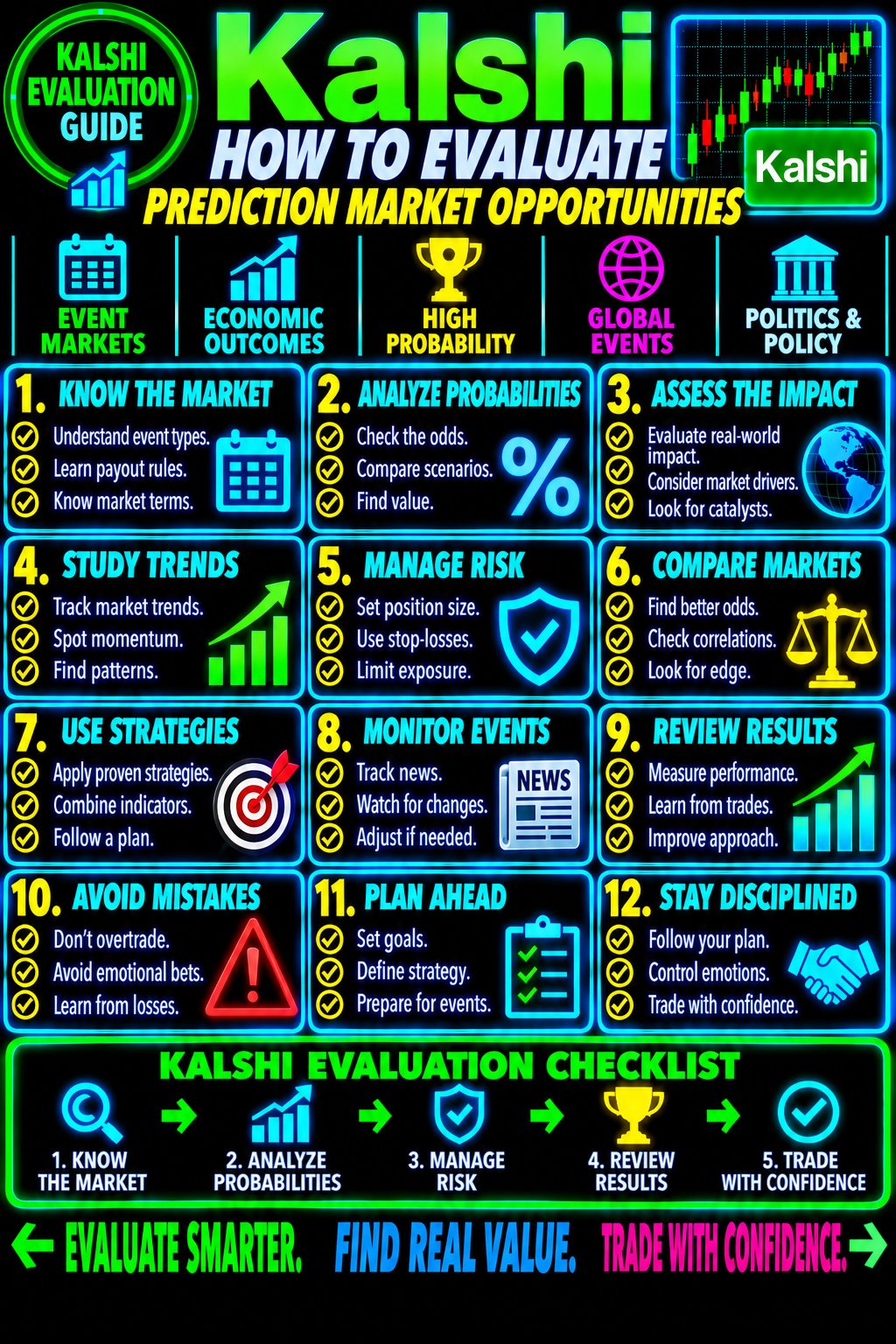
At Forex Trading Unlocked (FTU), we believe the foundation of evaluating any trading opportunity should involve five essential questions:
- What exactly is the event being measured?
- What probability is the market currently pricing?
- What is the realistic probability of the event occurring?
- Is there sufficient potential value to justify the trade?
- How much capital could be lost if the analysis is incorrect?
In this guide, we will walk through a systematic approach to evaluating Kalshi prediction market opportunities and identifying situations where the potential reward may justify the risk.
1. Understand Exactly What the Kalshi Contract Measures
Before evaluating a contract's price, you must understand what you are actually trading.
Kalshi contracts are based on specific event outcomes. Depending on the contract, the outcome may involve an economic number, a Federal Reserve decision, a political development, or another clearly defined event.
A YES contract generally pays $1 if the specified outcome occurs and $0 if it does not. A NO contract generally pays $1 if the specified outcome does not occur and $0 if it does.
However, the exact settlement rules matter.
For example, consider a hypothetical contract asking:
Will U.S. inflation exceed 3.0% in the next CPI report?
Before evaluating the contract, determine:
- Which CPI measurement is being used?
- Is the contract referring to year-over-year or month-over-month inflation?
- Which reporting period is covered?
- What official source determines the result?
- What happens if the reported number is exactly 3.0%?
- When does the contract settle?
These details can make a significant difference.
A trader might correctly anticipate that inflation will increase but misunderstand the specific measurement used by the contract.
That is not a market-analysis problem. It is a contract-evaluation mistake.
FTU Trading Principle: Never evaluate a prediction market contract until you understand precisely what constitutes a winning outcome.
2. Evaluate the Market-Implied Probability
One of the most important steps in evaluating Kalshi opportunities is understanding market-implied probability.
Kalshi contracts are generally priced between $0 and $1.
A contract trading at $0.65 represents an approximate 65% market-implied probability.
Contract Price Approximate Implied Probability
$0.10 10%
$0.20 20%
$0.30 30%
$0.40 40%
$0.50 50%
$0.60 60%
$0.70 70%
$0.80 80%
$0.90 90%
These are simplified interpretations of contract prices. Actual market pricing can be affected by bid-ask spreads, liquidity, fees, and trading conditions.Why Market-Implied Probability Matters
Suppose a YES contract is trading at $0.40.
The market is effectively pricing the outcome at approximately 40%.
However, your research suggests the event has a 60% probability of occurring.
That difference deserves further investigation.
The question becomes whether your estimate is supported by reliable information or whether you are simply more optimistic than the market.
This is where fundamental research and independent probability analysis become important.
3. Calculate Your Own Probability Estimate
Never assume that the market price represents the correct probability.
Market participants can be wrong, and prediction markets can react too aggressively or too slowly to new information.
Your job is to develop an independent probability estimate.Factors to Consider
Depending on the event, evaluate:
- Historical results.
- Current economic conditions.
- Recent data releases.
- Expert forecasts.
- Market expectations.
- Relevant statistical trends.
- New developments.
- Potential unexpected outcomes.
For example, suppose you are evaluating a Kalshi contract related to the next Federal Reserve interest-rate decision.
You might examine:
- Current inflation trends.
- Employment data.
- Recent Federal Reserve statements.
- Treasury market movements.
- Interest-rate futures expectations.
- Changes in economic forecasts.
After reviewing the evidence, you might estimate a 55% probability of a particular outcome.
If the contract is trading at $0.40, there may be an attractive theoretical opportunity.
However, your probability estimate must be sufficiently reliable to justify acting on the difference.
FTU Trading Principle: Your independent probability estimate is the foundation of your trading decision. Without it, you are simply following the market.
4. Calculate Expected Value Before Entering a Trade
Expected value is one of the most useful concepts for evaluating prediction market opportunities.
It allows traders to compare the potential financial outcome of a contract with their estimated probability of winning.
For a YES contract held through settlement:
EV - (P x 1) - C
Where:
- EV = Expected value per contract.
- P = Your estimated probability of winning.
- C = Contract purchase price.
This simplified calculation excludes fees and other transaction costs.Example: Evaluating a YES Contract
Suppose:
- Contract price: $0.40
- Your estimated probability: 60%
- Winning payout: $1.00
- Losing payout: $0.00
The calculation:
EV = (0.60 x 1.00) - 0.40
EV = $0.20
Positive estimated expected value
Your estimated gross expected value is $0.20 per contract.
That does not mean you will earn $0.20 on every trade.
It means that if your probability estimate is accurate and the same opportunity could be repeated under comparable conditions, the theoretical average outcome would be favorable before costs.
Comparing Different Opportunities
Contract PriceYour Probability Gross EV
A $0.30 45% +$0.15
B $0.45 60% +$0.15
C $0.70 75% +$0.05
D $0.80 65% -$0.15
Contract D illustrates an important point.
Even though the probability of winning is relatively high, the contract may be overpriced based on your estimate.
A high probability of winning does not automatically make a good trade.
The objective is to find value, not simply high-probability outcomes.
5. Evaluate the Bid-Ask Spread and Market Liquidity
A contract may appear attractive based on its displayed price, but the actual cost of entering and exiting a position can be significantly different.
This is why liquidity and bid-ask spreads must be evaluated before trading.Understanding the Bid-Ask Spread
The bid represents the price buyers are currently willing to pay.
The ask represents the price sellers are currently willing to accept.
For example:
Market Measurement Price
Best Bid $0.44
Best Ask $0.48
Midpoint $0.46
Midpoint $0.46
Spread $0.04
If you purchase immediately, you generally pay the ask price rather than the midpoint.
If you later sell immediately, you generally receive the bid price.
This difference can create a meaningful trading cost.What to Look For
Before entering a position, examine:
- Bid-ask spread.
- Available contracts at each price.
- Trading volume.
- Market depth.
- Recent transaction activity.
- Potential price slippage.
A contract with a wide spread may require a larger probability advantage to justify entering the position.Why Liquidity Matters
Imagine identifying a contract that appears to offer excellent expected value.
However, only a small number of contracts are available near the displayed price.
If you attempt to purchase a larger position, the average entry price could increase significantly.
The same problem can occur when attempting to exit.
A good theoretical opportunity is not necessarily an executable trading opportunity.
Related FTU resource:
Kalshi Market Liquidity and Bid-Ask Spreads
6. Evaluate the Time Remaining Until Settlement
Time is another important consideration when evaluating Kalshi contracts.
Two contracts can have similar implied probabilities but very different risk characteristics because of the time remaining before settlement.
Consider these hypothetical situations:
- Contract A settles tomorrow.
- Contract B settles in three weeks.
- Contract C settles in three months.
Each contract has different exposure to incoming information and unexpected developments.
Questions to Ask
- How much time remains before settlement?
- What important announcements could occur before then?
- Could new information materially change the probability?
- Is there enough time for the expected development to occur?
- Could the contract price become more volatile as settlement approaches?
The Importance of Event Timing
For example, a Federal Reserve contract may be heavily influenced by upcoming inflation and employment reports.
A trader evaluating the contract before those releases must consider how the new information could change market expectations.
A contract that appears attractive today may no longer offer value after the next economic announcement.
Time remaining is not simply a countdown. It represents the period during which the underlying probability can change.
7. Use Economic and Fundamental Analysis to Find Opportunities
This is an area where Forex traders may have an analytical advantage.
Many Kalshi contracts are connected to economic events that Forex traders already monitor.
Instead of evaluating a contract in isolation, examine the economic environment surrounding the event.
Important Economic Indicators
Economic Indicator What It Helps Evaluate
CPI Consumer inflation
PPI Producer-level inflation
PCE Federal Reserve inflation measure
NFP Employment growth
Unemployment Rate Labor-market conditions
GDP Economic growth
Retail Sales Consumer spending
Federal Funds Rate Monetary policy
Example: Evaluating an Inflation Contract
Suppose Kalshi offers a contract related to whether U.S. inflation will exceed a specified threshold.
Your analysis might include:
- Recent CPI readings.
- PPI trends.
- Energy prices.
- Housing and shelter inflation.
- Wage growth.
- Consumer spending.
- Economic forecasts.
You can then compare your research with the current contract price.
This creates a more structured approach than simply buying YES or NO based on a news headline.
Connecting Kalshi to Forex Trading
Inflation expectations influence Federal Reserve policy expectations.
Those expectations can influence Treasury yields, the U.S. Dollar Index, and currency pairs.
For example, changing expectations about U.S. inflation may influence EUR/USD and USD/JPY.
Kalshi can provide an additional source of information about how market participants are pricing specific economic outcomes.
Explore these related FTU guides:
- Kalshi Inflation Expectations and the U.S. Dollar
- Kalshi Fed Expectations and EURUSD Trading
- Kalshi Interest Rate Expectations and USDJPY
8. Evaluate Market Sentiment and Potential Overreactions
Prediction markets are influenced by the opinions and actions of market participants.
Sometimes new information produces a reasonable adjustment in contract pricing.
Other times, traders may overreact.
This creates situations worth investigating.
Potential Signs of Market Overreaction
- A sudden price movement following a headline.
- A large change in implied probability without substantial new evidence.
- Strong directional sentiment.
- A contract price that moves significantly away from your independent estimate.
- Rapid changes in trading activity.
For example, a YES contract may rise from $0.45 to $0.75 following an unexpected headline.
However, after researching the development, you determine that the event probability may only have increased to 55%.
The contract could now represent poor value despite the positive news.
The Contrarian Opportunity
A trader may consider the opposite position when the market appears to have overreacted.
But there is an important distinction between identifying an overreaction and simply betting against the crowd.
A contrarian trade still requires independent probability analysis.
Never assume the market is wrong just because prices have moved dramatically.
9. Compare Kalshi Opportunities With Other Financial Markets
One of the strongest ways to evaluate a Kalshi opportunity is to compare its pricing with information from related financial markets.
Financial markets frequently react to the same underlying economic developments.
However, they may reflect different expectations, time horizons, and risk factors.
Markets Worth Comparing
Market Information Provided
Kalshi Event-specific market pricing
Forex Currency valuations
Forex Currency valuations
Treasury Yields Interest-rate and economic expectations
Gold Monetary and inflation-related sentiment
Stock Futures Growth expectations and risk appetite
Fed Funds Futures Interest-rate expectations
Example: Federal Reserve Rate Decision
Suppose a Kalshi contract is pricing a 70% probability of a Federal Reserve rate cut.
You might compare that pricing with:
- Fed funds futures.
- Treasury yields.
- Recent inflation data.
- Employment reports.
- Federal Reserve communications.
- Currency market reactions.
If other markets are suggesting a different outlook, investigate the reason.
The discrepancy may indicate an opportunity, but it may also reflect differences in contract definitions or market pricing conventions.
Remember that multiple markets can provide confirmation without necessarily representing independent evidence.
10. Evaluate the Potential Return Relative to the Risk
A potential trading opportunity must offer sufficient compensation for the risk being assumed.
Consider a YES contract purchased at $0.30.
Measurement Amount
Purchase Price $0.30
Winning Payout $1.00
Gross Potential Profit $0.70
Maximum Gross Loss $0.30
Gross Reward-to-Risk 2.33:1
This means the potential gross profit is approximately 2.33 times the amount risked.
However, reward-to-risk alone does not determine whether the trade is attractive.
You must also consider the probability of winning.
Break-Even Probability
For a contract purchased at $0.30 and held to settlement, the break-even probability before costs is 30%.
If your estimated probability is 40%, the trade has positive theoretical expected value.
If your estimated probability is 25%, the trade has negative theoretical expected value.
This is why probability analysis and risk-reward analysis must be considered together.
11. Use Position Sizing to Control Your Exposure
Even when a contract offers favorable expected value, position sizing remains essential.
A trader can be correct about the probability advantage and still experience significant losses if too much capital is committed.
Suppose you have a $2,000 Kalshi trading account.
You decide that you do not want to risk more than 1.5% of your account on a single position.
Your maximum planned exposure is:
$2,000 x 0.015 = $30
Even when a contract offers favorable expected value, position sizing remains essential.
A trader can be correct about the probability advantage and still experience significant losses if too much capital is committed.
Suppose you have a $2,000 Kalshi trading account.
You decide that you do not want to risk more than 1.5% of your account on a single position.
Your maximum planned exposure is:
Measurement Amount
Account Capital $2,000
Planned Maximum Loss $30
Contract Price $0.50
Number of Contracts 60
Total Capital at Risk $30
Maximum Gross Payout $60
Maximum Gross Profit $30
This example assumes you hold the contracts through settlement.
If you plan to exit before settlement, your actual realized loss or profit depends on the price at which you can sell.
Also consider overlapping positions. Several contracts connected to the same economic event may create concentrated exposure.
Related FTU resource:
Kalshi Contract Position Sizing
12. The FTU Kalshi Opportunity Evaluation Checklist
Before entering a Kalshi position, use this checklist to determine whether the opportunity meets your trading requirements.
FTU Prediction Market Evaluation Checklist
Use this checklist to review a potential trade before committing capital.
Evaluation progress:
- I understand the exact contract settlement rules.
- I have identified the current YES and NO prices.
- I have calculated the market-implied probability.
- I have developed an independent probability estimate.
- My estimated probability provides a meaningful advantage.
- I have calculated expected value after estimated costs.
- The bid-ask spread is acceptable.
- There is sufficient liquidity for my position.
- I understand the time remaining until settlement.
- I have researched relevant economic and market information.
- I have evaluated the potential reward relative to the risk.
- My position size is appropriate for my account.
- I have considered exposure from related contracts.
Completing the checklist does not guarantee a profitable trade. It helps ensure that important evaluation steps are not overlooked.
13. Common Mistakes When Evaluating Kalshi Opportunities
Even experienced traders can make mistakes when entering prediction markets.
Here are some of the most important problems to avoid.
1. Confusing a High Probability With a Good Trade
A contract with an 85% implied probability may still be overpriced.
2. Ignoring Contract Details
The settlement rules determine the outcome, not your interpretation of the headline.
3. Following Market Sentiment Blindly
A popular opinion is not necessarily a correct opinion.
4. Ignoring Bid-Ask Spreads
Trading costs can eliminate an otherwise attractive theoretical advantage.
5. Overestimating Your Own Probability Forecast
Your estimate is not automatically more accurate than the market's.
6. Ignoring Upcoming Economic Events
New information can change the probability of an outcome before settlement.
7. Committing Too Much Capital
Even strong opportunities involve uncertainty.
8. Trading Every Available Market
There is no requirement to participate in every event.
The ability to recognize when an opportunity does not meet your standards is an important part of disciplined trading.
14. Building a Repeatable Kalshi Trading Evaluation System
The best way to improve your ability to evaluate prediction markets is to establish a repeatable process and measure the results.
At Forex Trading Unlocked, we recommend organizing the evaluation process into six stages.
Stage Primary Objective
Market Discovery Find potentially interesting contracts
Contract Analysis Understand the event and settlement rules
Probability Research Develop an independent estimate
Value Assessment Calculate expected value and trading costs
Risk Management Determine position size and maximum exposure
Performance Review Evaluate forecasts and actual results
Over time, record your estimated probabilities and compare them with actual outcomes.
For example, if you repeatedly assign 70% probabilities to events, approximately 70% of those events should occur over a sufficiently large and representative sample if your estimates are well calibrated.
This is known as probability calibration.
It is an important way to evaluate whether your research process is actually improving.
You should also measure profitability separately. Accurate probability estimates do not automatically guarantee profits if contract prices and trading costs are unfavorable.
15. Why Kalshi Prediction Market Analysis Matters to Forex Traders
Kalshi offers Forex traders another way to examine market expectations surrounding economic developments.
Traditional Forex analysis focuses on currency valuations, interest-rate differentials, monetary policy, economic data, and market sentiment.
Prediction markets introduce another dimension: the probability assigned to specific future events.
Consider how these areas connect:
- Inflation expectations can influence Federal Reserve policy.
- Federal Reserve expectations can influence Treasury yields.
- Treasury yields can influence the U.S. Dollar.
- Changes in the U.S. Dollar can influence EURUSD, GBPUSD, and USDJPY.
- Economic uncertainty can influence gold and broader market sentiment.
By monitoring these relationships, Forex traders can develop a broader understanding of the economic forces influencing financial markets.
However, Kalshi contract pricing should be treated as one analytical input rather than a substitute for traditional market research.
For additional reading, explore:
- Kalshi vs. Forex Trading
- How Kalshi Prediction Markets Connect to Forex Trading
- Kalshi Markets and Federal Reserve Expectations
- Kalshi Inflation Expectations and the U.S. Dollar
16. Explore More Kalshi Trading Education at Forex Trading Unlocked
Understanding how to evaluate a prediction market opportunity is an important first step toward developing a disciplined trading approach.
But probability analysis is only one part of the equation.
Traders must also understand contract pricing, liquidity, market expectations, economic fundamentals, position sizing, and risk management.
Forex Trading Unlocked is building a comprehensive educational resource connecting Kalshi prediction markets with traditional financial markets.
Whether you are an experienced Forex trader or just beginning to explore prediction markets, our goal is to help you develop the knowledge needed to evaluate opportunities more effectively.
Explore the FTU Kalshi Trading Education Center
Learn more about prediction markets, trading strategies, economic events, probability analysis, and risk management.
Continue Learning:
- Kalshi Trading Strategies
- Kalshi Contract Position Sizing
- Kalshi Risk Management for Prediction Market Traders
- Kalshi Market Liquidity and Bid-Ask Spreads
Final Thoughts: Find Value Before You Trade
The most important lesson when evaluating Kalshi prediction market opportunities is that a good trading opportunity requires more than a strong opinion about an upcoming event.
It requires a measurable difference between the price you are paying and the probability you believe is justified by the available evidence.
The best traders do not simply ask whether an event will happen.
They ask whether the contract price offers sufficient value, whether the potential reward justifies the risk, and whether their research supports the decision.
By combining independent probability estimates, expected-value calculations, economic research, liquidity analysis, and disciplined position sizing, traders can approach Kalshi with a more systematic methodology.
Remember: Don't chase predictions. Evaluate probabilities. Find value. Control risk.
Forex Trading Unlocked — Unlocking the Markets, One Strategy at a Time.
👉 “Get Instant Access (Check Your Email)”
💥 IMPORTANT: One Last Step Required
After you enter your email, check your inbox (or spam folder) for a confirmation email.
👉 Click the confirmation link so I can send you your free Forex training.
⚠️ If you don’t confirm, I can’t send you anything.
👉 “⚠️ Access expires if not confirmed within 24 hours minutes.”
👉 “Takes 10 seconds. Instant access after email confirmation.”